USAID DEC
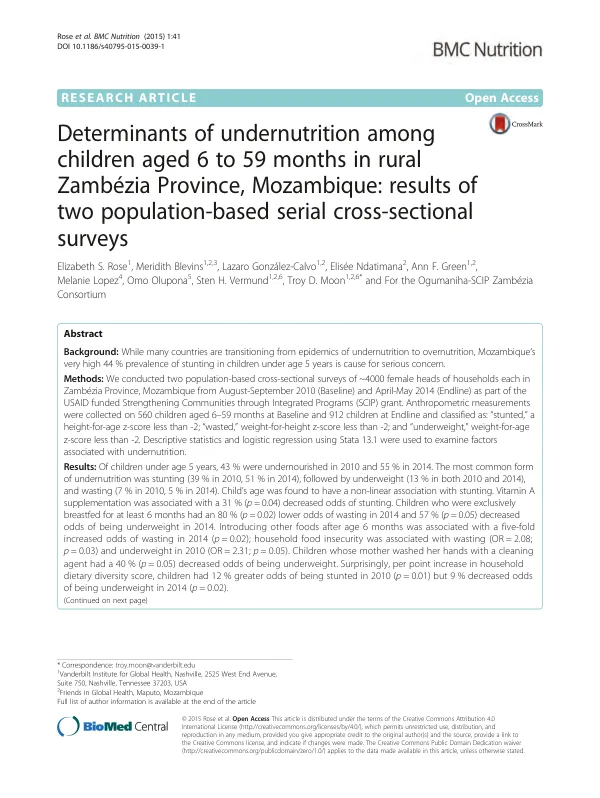
Determinants of undernutrition among children aged 6 to 59 months in rural Zambézia Province, Mozambique: results of two population-based serial cross-sectional surveys
Sign inWORLD HEALTH ORGANIZATION
Determinants of undernutrition among children aged 6 to 59 months in rural Zambézia Province, Mozambique: results of two population-based serial cross-sectional surveys
In Mozambique's Zambézia Province, the prevalence of stunting in children under age 5 years is a cause for serious concern, with a 44% prevalence rate.
2015 · 11 pages
Sign in to readA free account is required to download.
Abstract
Two population-based cross-sectional surveys were conducted in 2010 and 2014, with a total of approximately 4000 female heads of households participating. Anthropometric measurements were collected on 560 children aged 6-59 months at the baseline survey and 912 children at the endline survey. The most common form of undernutrition was stunting, with 39% of children under age 5 years being stunted in 2010 and 51% in 2014. Child's age was found to have a non-linear association with stunting, with younger children being more likely to be stunted. Vitamin A supplementation was associated with a 31% decreased odds of stunting, while children who were exclusively breastfed for at least 6 months had an 80% lower odds of wasting in 2014. Household food insecurity was associated with wasting and underweight in 2010, while introducing other foods after age 6 months was associated with a five-fold increased odds of wasting in 2014. Children whose mother washed her hands with a cleaning agent had a 40% decreased odds of being underweight. Surprisingly, per point increase in household dietary diversity score, children had 12% greater odds of being stunted in 2010 but 9% decreased odds of being underweight in 2014. The determinants of undernutrition in Zambézia Province are complex and multifaceted, involving both household and individual level factors. A combination of interventions, including nutrition education, food supplementation, and healthcare access, may be necessary to address the issue of undernutrition in this population. The findings of this study highlight the need for a comprehensive approach to addressing undernutrition in Zambézia Province, one that takes into account the social, economic, and cultural context of the population.
Related documents