USAID DEC
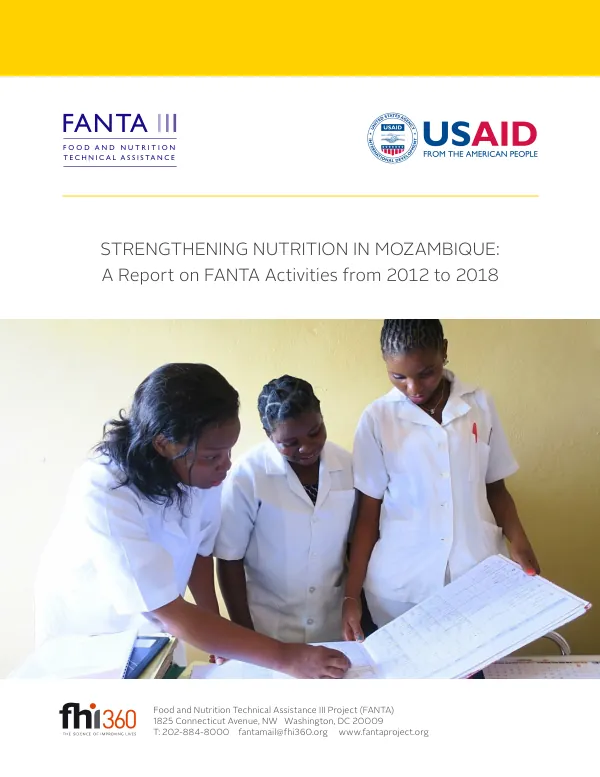
Strengthening Nutrition in Mozambique: A Report on FANTA Activities from 2012 to 2018
Sign inFHI 360
Strengthening Nutrition in Mozambique: A Report on FANTA Activities from 2012 to 2018
The Government of Mozambique has prioritized fighting malnutrition, a key public health concern.
2018 · 26 pages
Sign in to readA free account is required to download.
Abstract
Despite economic growth, the country has a high prevalence of malnutrition, with 43% of children suffering from stunting and 6% from wasting. Malnutrition is the underlying cause of 45% of deaths in children under 5 years of age globally. In Mozambique, malnutrition results in annual losses of US$1.6 million, nearly 11% of the country's gross domestic product. The Government of Mozambique has taken a multifaceted approach to address malnutrition, including joining the Scaling Up Nutrition (SUN) movement and developing strategies to ensure nutrition support for people with HIV and/or tuberculosis (TB). Between 2012 and 2018, the Food and Nutrition Technical Assistance III Project (FANTA) partnered with the Government of Mozambique to strengthen the country's capacity to address malnutrition. FANTA received funding from the U.S. Agency for International Development (USAID)/Mozambique, the U.S. President's Emergency Plan for AIDS Relief (PEPFAR)/Mozambique, and Feed the Future (FTF)/Mozambique. FANTA provided technical support at the national and sub-national levels to establish, lead, and deliver high-quality nutrition services. At the national level, FANTA supported the development of policies, strategies, programs, technical materials, and data management systems, resulting in stronger programming, improved systems, and staff better equipped to manage and deliver services. FANTA's technical support at the national level focused on strengthening the Nutrition Rehabilitation Program (PRN) service delivery. PRN has five pillars: community engagement, inpatient treatment for severe acute malnutrition (SAM) with medical complications, outpatient treatment for SAM without medical complications, outpatient treatment for moderate acute malnutrition (MAM), and nutrition counseling and education. The program includes a special focus on groups at higher risk of malnutrition, such as people with HIV and/or TB, pregnant and lactating women, and the elderly. FANTA created the materials for PRN service delivery by consulting global technical documents and key nutrition and dietetics resources, conferring with other countries' ministries to learn about their guidelines and experience, and leading technical discussions through the PRN technical working group. FANTA's support at the national level resulted in the development of 14 national-level policies and strategies with nutrition content, training of 1,600 people in nutrition-related topics and processes, and the development of key programmatic materials for nationwide nutrition service provision. These materials included training manuals, job aids, quality improvement tools, supervision tools, and data management systems. FANTA also supported the development of the PRN Manual for the Treatment and Rehabilitation of Malnutrition, Volume I for children and adolescents 0-14 years of age, and Volume II for adolescents and adults over 15 years of age. The PRN program has been a cornerstone of the Government of Mozambique's efforts to address malnutrition. With FANTA's technical support, Mozambique became one of the first countries to develop a comprehensive program to manage malnutrition among all age groups and across a spectrum of needs. The program has been launched countrywide, with PRN I launched in 2011 and PRN II in 2016. FANTA's technical support has been critical in establishing and strengthening PRN service delivery, and the program has shown promising results in addressing malnutrition in Mozambique.
Related documents