USAID. BUR. FOR POLICY AND PROGRAM COORDINATION. CENTER FOR DEVELOPMENT INFORMATION AND EVALUATION (CDIE)
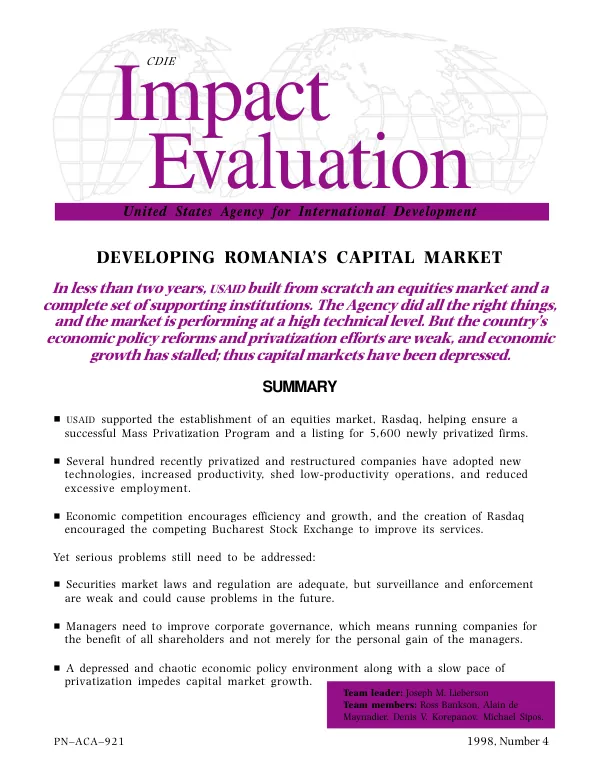
Developing Romania"s capital market
In 1995, USAID began a project to develop an equities market, named Rasdaq, to complement the Bucharest Stock Exchange, established that same year with help from the Canadian government.
Lieberson, Joseph M.; de Maynadier, Alain · 1970
Sign in to readA free account is required to download.
Abstract
In less than 2 years, USAID created Rasdaq and a complete set of supporting institutions, including a Mutual Funds Association and depository, registry, transfer agent, and self-regulatory organizations. Rasdaq helped ensure a successful Mass Privatization Program and a listing for 5,600 newly privatized firms. As a result, several hundred recently privatized and restructured companies have adopted new technologies, increased productivity, and reduced excessive employment. Further, the creation of Rasdaq encouraged the competing Bucharest Stock Exchange to improve its services. Several factors were critical to the project"s success -- the active role taken by the U.S. ambassador in negotiations with the government; the direct linking of the project with a major mass privatization of small and medium-size firms; the large outlay of funds ($30 million); USAID"s use of a turnkey approach covering all needed elements; the authority enjoyed by USAID"s Bureau for Europe and the New Independent States to hire highly skilled capital market experts to manage the project; and adoption of a tight time frame focused on getting all systems in place and operating within 6 months and fully functioning within a year. Yet serious problems remain. While securities market laws and regulations are adequate, surveillance and enforcement are weak. Managers need to improve corporate governance, i.e., run companies for the benefit of all shareholders and not merely for the personal gain of the managers. Finally, due to the continuing prevalence of communist ideas in government and throughout the economy, the economic policy environment is depressed and chaotic, and additional privatization has proceeded slowly. As long as the government fails to adopt and implement needed economic reforms, Rasdaq and other capital market institutions will not live up to their full potential. The following lessons were learned: (1) Top-level support, healthy funding, and a firm timetable can spur the success of a capital markets program. (2) Economic competition encourages efficiency and growth, but also creates duplication and overlap. It may be time to merge some of the competing institutions, including, at some point in the future, Rasdaq and the Bucharest Stock Exchange. (3) An independent regulatory commission with strong enforcement powers is critical. (4) Incentives for good corporate governance need to be instituted. (5) A stock market alone does not make a capital market. Romania still lacks a private debt market (corporate bonds), a secondary market in government securities, longer term government bonds, a municipal finance market, and money market instruments. Moreover, commercial credit in many cases is still allocated by administrative decision rather than market and price decisions. (6) Absent a sound economic environment, even good institutions cannot yield the full benefits of privatization.