USAID. BUR. FOR POLICY AND PROGRAM COORDINATION. CENTER FOR DEVELOPMENT INFORMATION AND EVALUATION (CDIE)
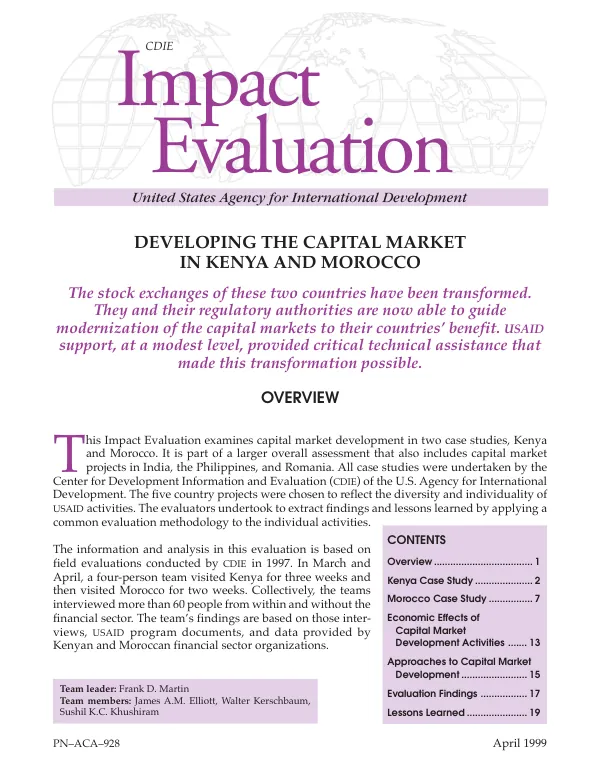
Developing the capital market in Kenya and Morocco
Case studies of USAID capital market development projects in Kenya and Morocco are presented.
Martin, Frank D.|Elliott, James A. M. · 1999
Sign in to readA free account is required to download.
Abstract
The report covers the country situations in which the projects were implemented, the projects themselves and their expected and actual economic effects, and the different approaches to capital market development that governed the projects. Detailed project-specific findings and general lessons learned are presented in conclusion. Overall, the stock exchanges of both Kenya and Morocco have been transformed. They and their regulatory authorities are now able to guide modernization of the capital markets to their countries' benefit. USAID support, at a very modest cost, provided critical technical assistance that made this transformation possible. Among other accomplishments, the projects helped install sound, well-managed capital market institutions such as regulatory agencies and stock-trading exchanges, and helped instill good corporate governance in listed companies, protecting stockholders from managerial venality. As to problem areas, there seems to be little inclination on the part of Kenyan commercial bankers to advance the development of the capital market (in contrast to bankers in Morocco). Also USAID planners in both countries underestimated the reluctance of companies (for a variety of proprietary reasons) to list on stock exchanges. The following lessons were learned: (1) Capital market development need not be an expensive undertaking. The Kenya activity was clearly a development bargain. A basic exchange and regulatory structure now operate at a modest cost to both the government of Kenya and USAID. (2) Privatization programs give a boost to equity market projects. Share offerings of state-owned enterprises give the market something to work with as the institutions tool up. Retail investors are more easily attracted by offerings of well-known national flagship companies. It can safely be concluded that privatizations through the stock market aided efforts to develop capital markets. (3) A commercial banking sector willing to innovate will magnify the positive effects of donor-funded development activities. Morocco's commercial banks are more innovative than Kenya's. The range of financial services and products available to companies of all sizes is greater in Morocco. Analysis of capital market development design should include an assessment of the likely response of the commercial banking sector to new opportunities. (4) Missions undertaking capital market projects should be held accountable for the quality of the institutions they assist but not for the level of market activity. Stock and bond markets reflect the state of the national economy, which itself is the result of host government economic policies, the underlying structure of the economy, and external factors. Market indices will rise and fall during and after USAID activity, the goal of which should be to help put in place institutions capable of meeting the financial intermediation demands of the private sector. (5) USAID designers underestimated the reluctance of firms to list on stock exchanges. Promotional efforts in both activities were directed to attracting retail investors to the market. Because these promotional efforts succeeded, the demand for securities increased. Meanwhile, however, the only supply increase came from the privatization programs. The combined result: an overall shortage in the supply of securities relative to demand. Activity designers need to examine the attitudes of and the incentives accorded private firms considering entry into the stock exchange. (6) Activity implementors should take a flexible attitude toward adopting the American model for the capital market regulatory structure, which relies heavily on self-regulatory organizations. Delegation of regulatory functions to NGOs may not be acceptable to governments outside the Anglo-American legal tradition. The decision on the type of regulatory framework need not be an either or decision. (7) An active stock exchange imposes managerial discipline in widely held listed firms. Managers of listed firms in both Kenya and Morocco said that stockholder oversight, while not always welcome, did induce them to increase the efficiency of their plant and equipment. Efficiency gains occurred in, but were not limited to, privatized firms.
Related documents