USAID. BUR. FOR POLICY AND PROGRAM COORDINATION. CENTER FOR DEVELOPMENT INFORMATION AND EVALUATION (CDIE)
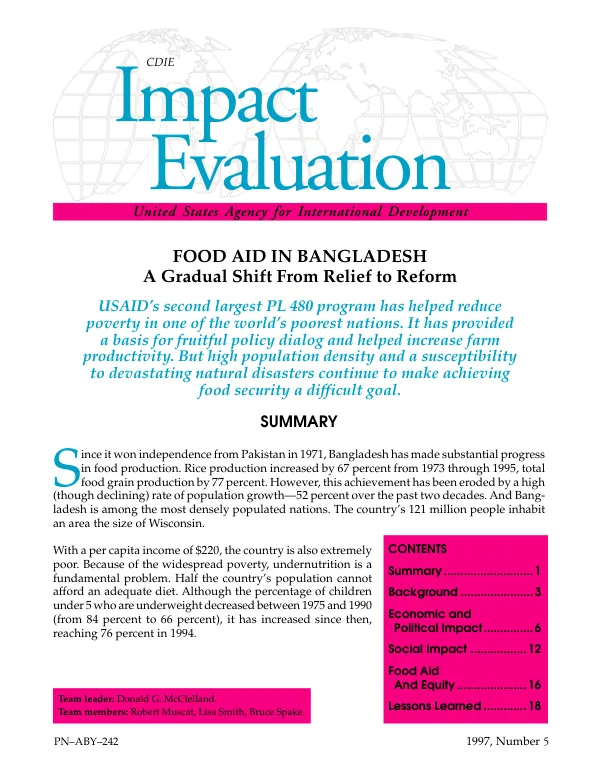
U.S. food aid and sustainable development : forty years of experience
From 1954 through 1996, the United States provided more than $52 billion of P.L.
McClelland, Donald G. · 1998
Sign in to readA free account is required to download.
Abstract
480 food aid worldwide both to alleviate hunger and to promote long-term sustainable development. This report assesses the contribution of that aid to long-term sustainable development by examining the economic, social, and political impact of food aid in five recipient countries (Bangladesh, Ethiopia, Ghana, Honduras, and Indonesia) and the Sahel region. The equity of food aid targeting and the efficiency of food aid as a mechanism for transferring resources are also explored. For the most part, the U.S. food aid program has contributed to sustainable development, more so in some countries than in others. Besides providing balance-of-payments support, food aid can leverage or support a sound economic policy environment (Bangladesh, Indonesia, some Sahelian states such as Mali). But it can also have a negative effect on economic policy (Honduras in the 1980s, some Sahelian states), or no discernible effect at all (Ghana before the mid-1980s, some Sahelian states, Ethiopia until recently). Political stability, a precondition for sustainable development, is at risk in low-income countries (such as Bangladesh) when food prices are high and fluctuate widely. Food aid can help stabilize food prices and, perhaps, contribute to political stability. This seemed to be the case in Indonesia in the late 1960s and early 1970s and in Honduras in the mid-1980s. However, food aid cannot ensure political stability (the Sahel, Ghana, Ethiopia). Food aid can have a negative effect on long-term sustainable development if it enables governments to put off implementing food policies that encourage grain production. This occurred to some extent in Honduras, Ghana, and some Sahelian states. It may also depress domestic grain prices, thus reducing incentives to produce grain, as probably occurred at certain times in Bangladesh and Honduras, but also benefitting consumers. U.S. food aid has had its greatest social impacts through project food aid, which directly distributes food to vulnerable groups through school feeding, food-for-work (FFW), and maternal and child health (MCH) programs. FFW projects have been especially successful in reaching intended beneficiaries, although the public works created under such projects have been of mixed quality, particularly when they began as short-term relief and rehabilitation operations rather than as long-term development programs. MCH programs seem to have improved the health and nutritional knowledge of poor mothers, one of the program's three objectives. However, several factors made it difficult to demonstrate the programs' effect on the nutritional status of children under 5, a second program objective. First, older MCH programs often relied solely on food supplementation without any complementary inputs such as primary health care; these programs had no discernible effect on children's nutritional status. In cases in which nutritional status did improve, the effect of the food supplement could not be disengaged from that of other factors affecting nutritional status, such as vaccinations, potable water, and increased incomes. Finally, the food ration was often shared among family members rather than consumed solely by lactating mothers and children (Ethiopia, Honduras, Indonesia, the Sahel). However, other evaluations (e.g., Mora and others 1990) have found MCH supplementary feeding programs in some countries effective at improving child nutritional status when they included complementary health and education inputs. USAID has used food aid to support school feeding programs in two Sahelian countries (Burkina Faso and the Gambia), Bangladesh, Ghana, and Honduras, but not in Ethiopia or Indonesia. Results, though mixed, have generally been positive, except in Ghana, where none of the program's objectives were achieved. Program food aid, although sold on the open market to anyone with money, can benefit the poor indirectly by promoting an equity-oriented policy environment (Indonesia, Bangladesh); also, local currency generated from the sale of food aid can be invested where the poor live and work -- usually in rural areas growing crops (as occurred in all six countries). However, while it is more efficient to transfer resources as financial aid rather than as food aid, in practice U.S. financial aid is not fungible with U.S. food aid. Therefore, the choice is not between food aid and financial aid, but between food aid and no aid. Six recommendations to guide future programs are provided. Includes bibliography. (Author abstract, modified)