USAID DEC
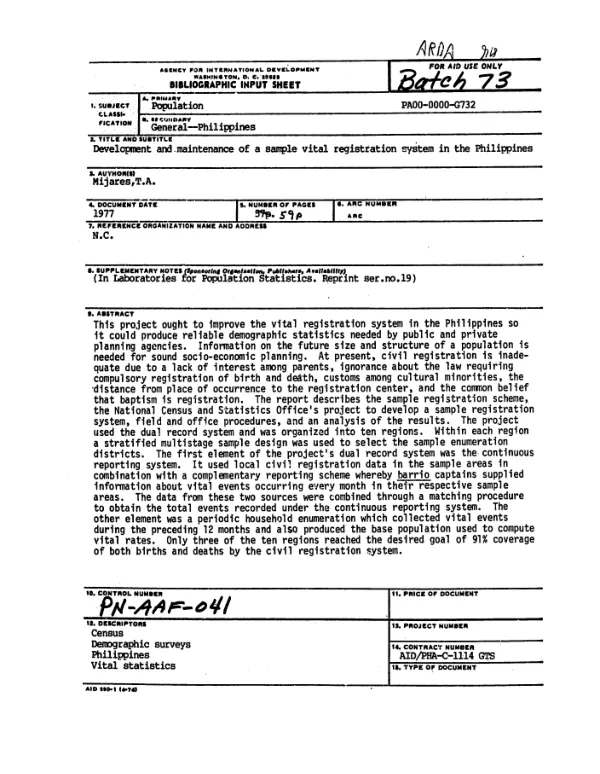
Development and maintenance of a sample vital registration system in the Philippines
Sign inUNIVERSITY OF NORTH CAROLINA AT CHAPEL HILL
Development and maintenance of a sample vital registration system in the Philippines
This project seeks to improve the vital registration system in the Philippines so that it can produce reliable demographic statistics needed by public and private planning agencies.
Mijares, T. A. · 1970
Sign in to readA free account is required to download.
Abstract
Information on the future size and structure of a population is needed for sound socio-economic planning. At present, civil registration is inadequate due to a lack of interest among parents, ignorance about the law requiring compulsory registration of birth and death, customs among cultural minorities, the distance from place of occurrence to the registration center, and the common belief that baptism is registration. The report describes the sample registration scheme, the National Census and Statistics Office"s project to develop a sample registration system, field and office procedures, and an analysis of the results. The project used the dual record system and was organized into ten regions. Within each region a stratified multistage sample design was used to select the sample enumeration districts. The first element of the project"s dual record system was the continuous reporting system. It used local civil registration data in the sample areas in combination with a complementary reporting scheme whereby barrio captains supplied information about vital events occurring every month in their respective sample areas. The data from these two sources were combined through a matching procedure to obtain the total events recorded under the continuous reporting system. The other element was a periodic household enumeration which collected vital events during the preceding 12 months and also produced the base population used to compute vital rates. Only three of the ten regions reached the desired goal of 91% coverage of both births and deaths by the civil registration system.