USAID
Development Data Library (DDL)
The Development Data Library (DDL) is a web-based solution being explored by USAID to catalog and make available its extensive data assets.
2014 · 1 pages
Sign in to readA free account is required to download.
Abstract
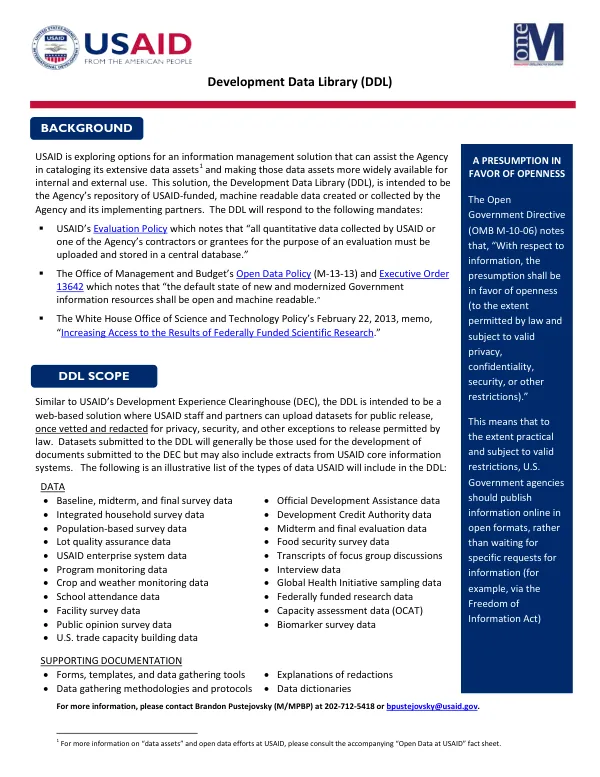
The DDL aims to be the Agency's repository of USAID-funded, machine-readable data created or collected by the Agency and its implementing partners. This solution responds to several mandates, including USAID's Evaluation Policy, the Office of Management and Budget's Open Data Policy, and the White House Office of Science and Technology Policy's memo on increasing access to the results of federally funded scientific research. The DDL is similar to the Development Experience Clearinghouse (DEC) and is intended to be a web-based platform where USAID staff and partners can upload datasets for public release, once vetted and redacted for privacy, security, and other exceptions to release permitted by law. The datasets submitted to the DDL will generally be those used for the development of documents submitted to the DEC, but may also include extracts from USAID core information systems. The types of data USAID will include in the DDL include baseline, midterm, and final survey data, official development assistance data, integrated household survey data, and development credit authority data, among others. The DDL will also include supporting documentation, such as forms, templates, and data gathering tools, explanations of redactions, data gathering methodologies and protocols, and data dictionaries. This documentation will provide context and clarity for the data included in the DDL. The Open Government Directive notes that the presumption should be in favor of openness, to the extent permitted by law and subject to valid restrictions. This means that USAID should publish information online in open formats, rather than waiting for specific requests for information. The DDL is intended to make USAID's data assets more widely available for internal and external use, and to support the Agency's evaluation and development efforts. By providing a centralized repository for USAID's data, the DDL will facilitate the sharing and reuse of data, and support the development of new research and analysis. The DDL will also help to increase transparency and accountability in USAID's development programs, and support the Agency's efforts to improve the effectiveness and impact of its investments.