USAID. BUR. FOR SCIENCE AND TECHNOLOGY. OFC. OF HEALTH
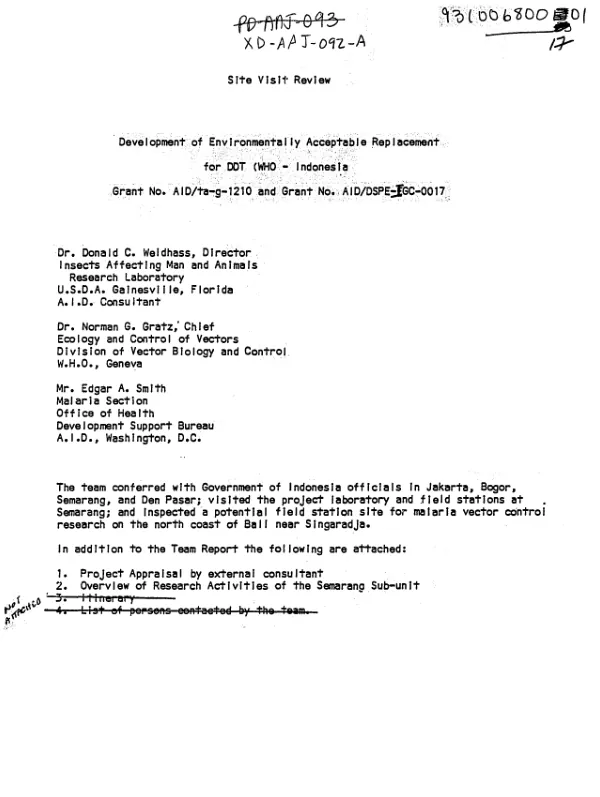
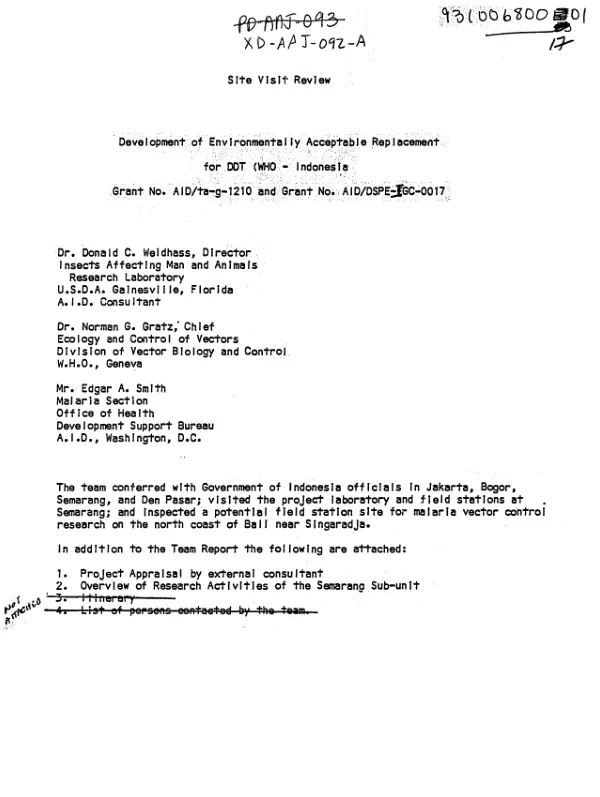
Development of an environmentally acceptable replacement for DDT
Evaluates project to test environmentally acceptable alternatives to DDT for use in anti-malaria programs.
1981
Sign in to readA free account is required to download.
Abstract
Evaluation, based on the attached Team Report (XD-AAJ-092-A), covers the period 6/78-4/81. The World Health Organization (WHO) facility in Indonesia conducted both house-scale (Stage IV) and village-scale (Stage IV and V) field trials of all major types of insecticides -- chlorinated hydrocarbons, organophosphorous compounds, carbamates, and synthetic pyrethroids. Fenitrothion and pirimphos-methyl were the only residual insecticides which showed sufficient biological activity (i.e., residual persistence and air-borne toxicity) throughout both tests. Fenitrothion was effective at both a high and low dosage, although frequent respraying was required with low dosage. Because it is more expensive than DDT, a selective spray method was developed which utilizes fenitrothion sparingly. Pirimphos-methyl was also effective at high and low dosages, but high dosage caused surface spotting and eroded sprayer nozzles. The assessment of Decamethrin as ineffective was based on incomplete trials; final conclusions should await completion of these trials. Field tests of malathion using dosages and formulations highly effective against mosquitoes in other parts of the world showed the compound to be ineffective--a significant discovery since malathion is the standard DDT replacement in much of the world-- and thus avoided the expenditure of large sums of money on an unsatisfactory treatment. This result also demonstrated that it is often impossible to predict the local applicability of even a "broad spectrum" insecticide. The evaluators concluded that developing safe alternatives to DDT remains both a regional (i.e., Asian) and worldwide priority. In addition, although residual spraying is still the most cost-effective method of malaria control, the rising costs of insecticides makes it imperative to investigate other control methods (e.g., attacking larval habitats, changing irrigation practices, and testing biological control agents). Given this situation, A.I.D. has decided to extend the WHO/Indonesia grant 1 year and is designing a comprehensive vector control program.