USAID DEC
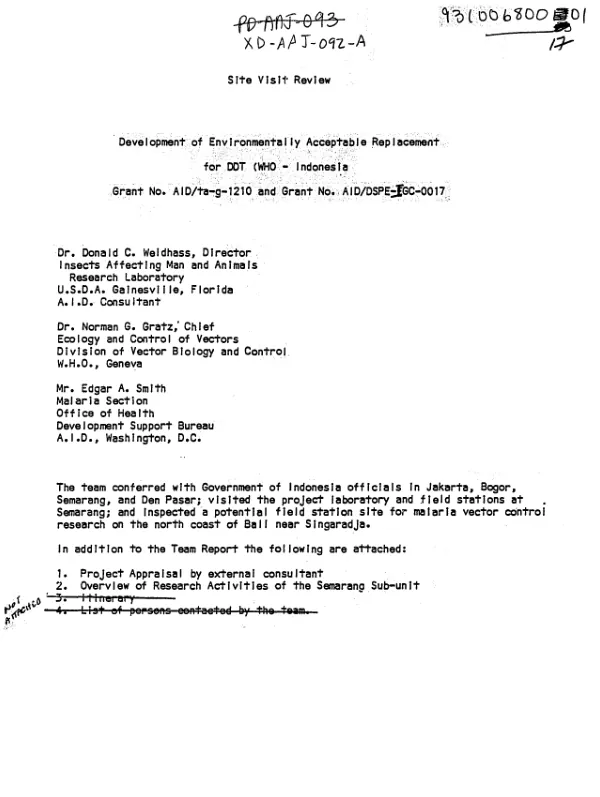
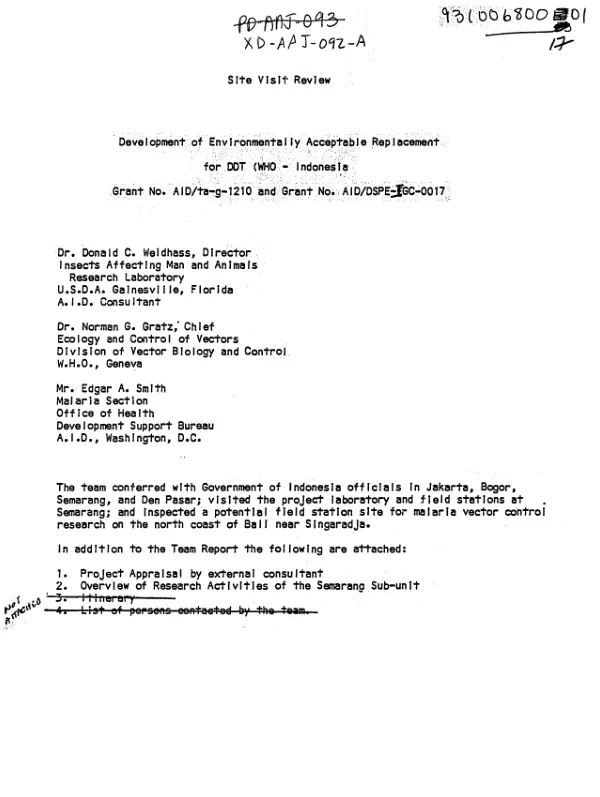
Development of environmentally acceptable replacement for DDT; site visit review
Evaluates project to develop an environmentally acceptable insecticide to control DDT-resistant Anopheles aconitus mosquitoes.
1980
Sign in to readA free account is required to download.
Abstract
Special evaluation, attached to a PES (PD-AAJ-092), covers the period 6/78-4/81 and is based on interviews with local project personnel and on site visits to Semarang and Bali, Indonesia. The Vector and Rodent Control Research Unit (VRCRU) in Jakarta and its sub-unit in Semarang have demonstrated a unique ability to conduct house-scale (Stage IV) and village-scale (Stage V) field trials of alternative insecticides. The evaluators recommend beginning or continuing research on: (1) new (as well as proven) insecticides and applicant equipment, emphasizing areas where the Anopheles vectors of malaria are already resistant to DDT and other chlorinated hydrocarbons; (2) developing and evaluating the ultralow volume concept of adult anopheline control; (3) developing comprehensive, integrated methods of malaria vector control (e.g., attacking larval habitats, changing irrigation practices, and testing biological control agents), possibly including methods which reduce the amount of residual spray; and (4) the ecology of malaria vectors on Java, Bali, and the Outer Islands, focusing on mosquito breeding in irrigation and brackish water (e.g., rice fields, fish ponds, and lagoons) and also exploring the location and seasonal variations of larval populations and of adult movements and resting habits. In addition, special efforts should be made to involve and facilitate technology transfer to Indonesian and other Asian government personnel, and a coordinating committee, including representatives of organizations concerned with malaria research in Indonesia, should be formed. Finally, it is recommended that the project be extended and gradually expanded to incorporate the suggested research topics over a 3-year period.