USAID DEC
Development process for improving irrigation water management on farms; executive summary
Sign inCOLORADO STATE UNIVERSITY. ENGINEERING RESEARCH CENTER
Development process for improving irrigation water management on farms; executive summary
Experience has clearly shown that effective on-farm water management can significantly increase agricultural and labor productivity and improve rural income distribution in developing countries.
Skogerboe, Gaylord V.; Lowdermilk, Max K. · 1970
Sign in to readA free account is required to download.
Abstract
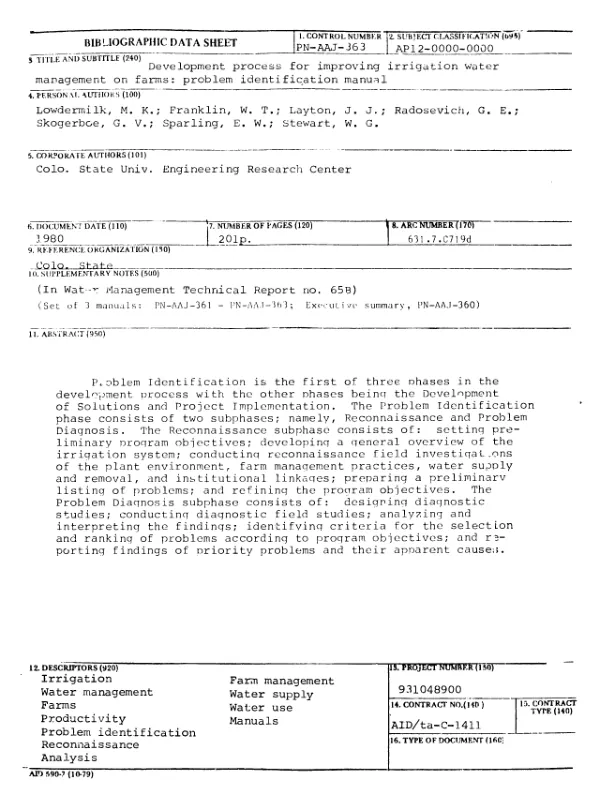
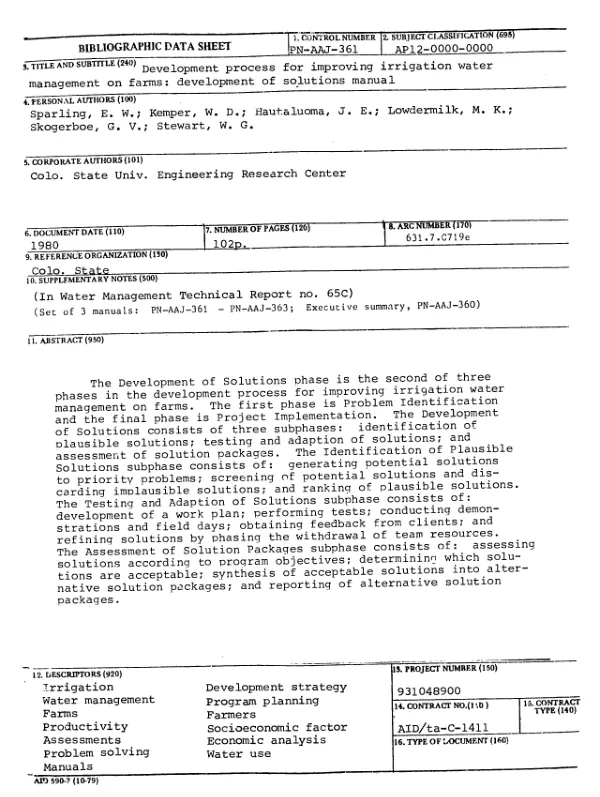
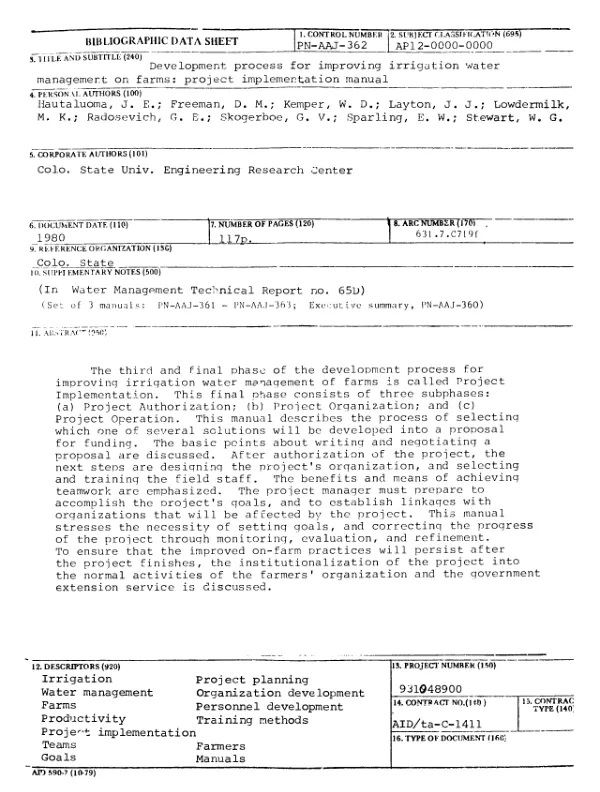
This report, directed toward project managers and summarizing three separate volumes, describes a comprehensive, interdisciplinary process which relies on farmer and client involvement to improve on-farm management of large-scale irrigation projects. The process entails physical and social scientists: (1) working together with farmers to identify the major constraints to agricultural productivity and resource conservation; (2) developing acceptable solutions to priority problems in collaboration with farmers; and (3) implementing a package of solutions utilizing both government and farmer resources. These three areas are addressed by the other manuals which comprise this set. The Problem Identification manual describes using reconnaissance findings to design, conduct, analyze, and interpret the results of detailed diagnostic field studies; selecting criteria to rank those problems discovered; and reporting on priority problems and their apparent causes. The Development of Solutions manual outlines a process to generate, screen, and rank plausible solutions; develop a workplan to test these solutions in relation to program objectives, determine the need for more information or work, synthesize the solutions into alternative packages, and report on the outcomes. The Project Implementation manual outlines the areas of project authorization -- reviewing the solution package, identifying the project approach, preparing objectives, and obtaining project authorization; project organization -- selecting personnel, developing institutional linkages, and specifying project management; and project operation -- operationalizing objectives, developing a work plan and time schedule, generating farmer participation, and monitoring progress. In conclusion, the authors caution that although the manuals are organized separately and appear distinct, they do overlap and are intended to be used together.