USAID DEC
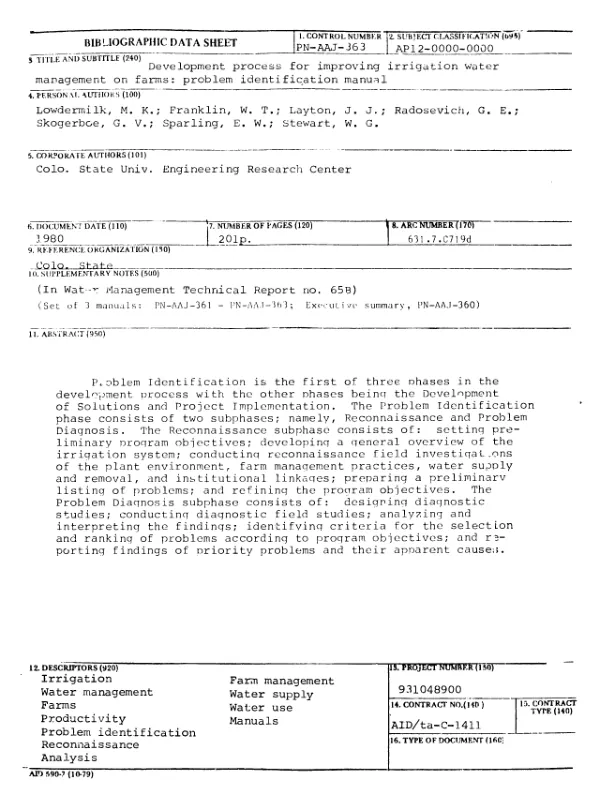
Development process for improving irrigation water management on farms : problem identification manual
Sign inCOLORADO STATE UNIVERSITY. ENGINEERING RESEARCH CENTER
Development process for improving irrigation water management on farms : problem identification manual
Experience has clearly shown that effective on-farm water management and control can significantly increase agricultural productivity and improve rural income distribution in developing countries.
Lowdermilk, Max K.; Franklin, W. T. · 1970
Sign in to readA free account is required to download.
Abstract
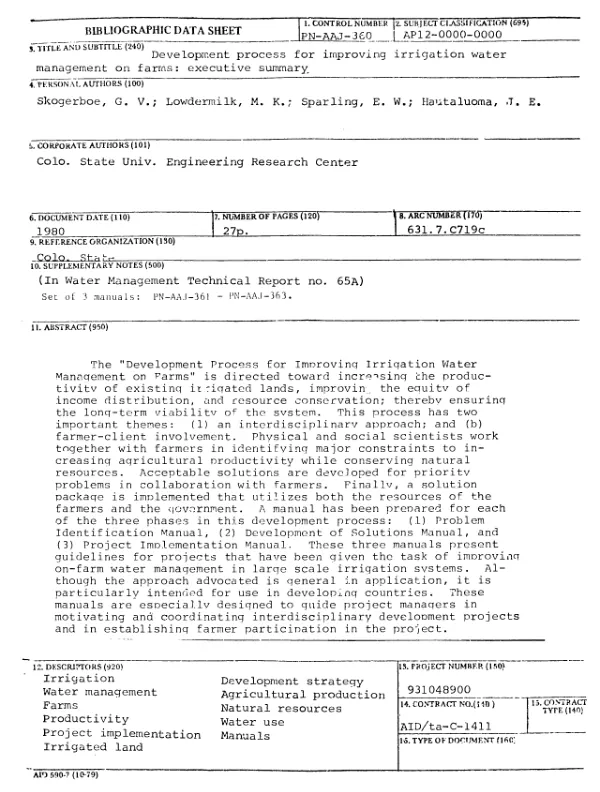
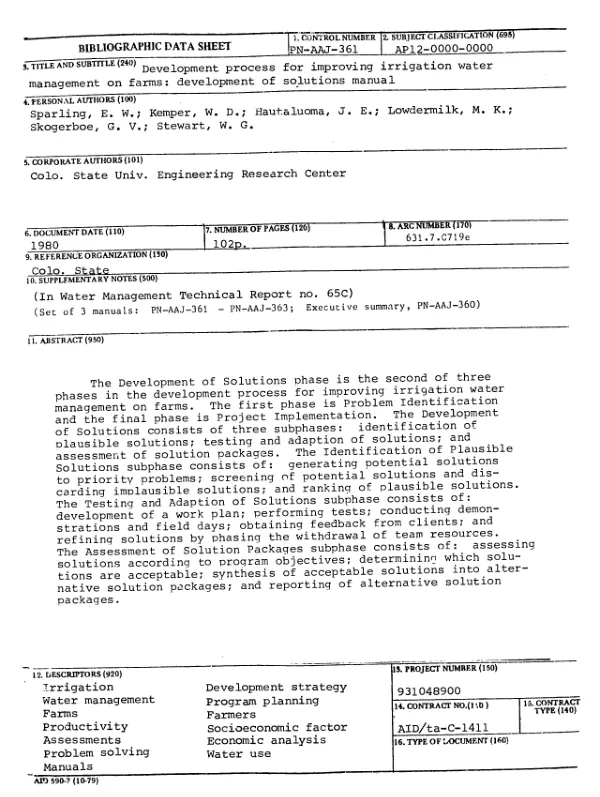
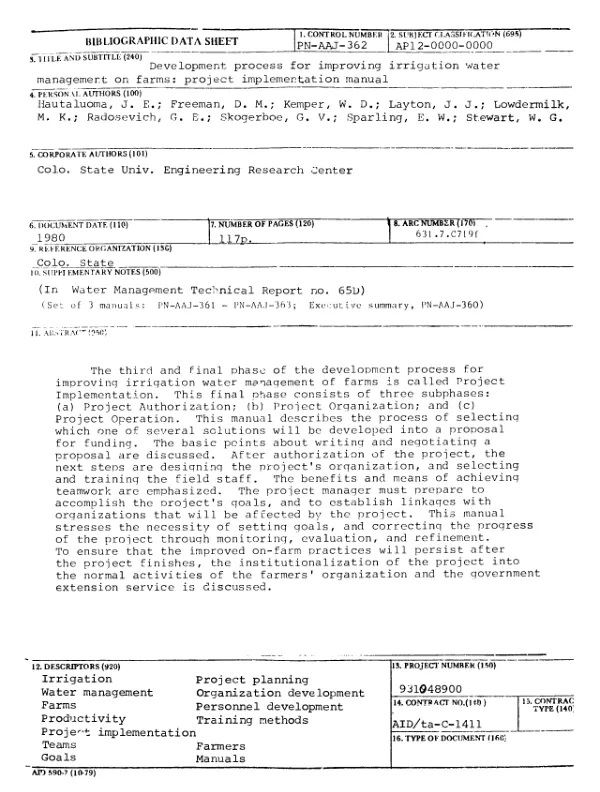
This volume, one of a series on a comprehensive process for improving on-farm irrigation water management in developing countries, offers guidelines, concepts, procedures, and methods for identifying factors which inhibit efficient functioning of farm irrigation systems. Problem identification has as its goals: understanding the traditional farming system and its interrelated components; identifying constraints to production, especially on small farms; and providing data which can be used in designing projects for upcoming growing seasons. The authors emphasize the importance of employing an interdisciplinary research team of engineers, sociologists, economists, and agronomists and encouraging active farmer participation. Major problem identification activities can be divided between reconnaissance and diagnosis. The former includes: (1) developing a general overview of the farm irrigation system -- summarizing available research, meeting with officals from relevant institutions, and conducting informal interviews with selected farmers; (2) organizing and implementing initial field visits; (3) compiling a preliminary list of problems; and (4) refining program objectives. The latter comprises: (1) designing and conducting diagnostic field studies of the plant environment (crops, cropping patterns, and soils); farm management practices (irrigation, cropping, and budgeting practices); water supply and removal (the command area and the source, availability and quality of irrigation water); and institutional linkages between the irrigation system, agricultural infrastructure, and the sociocultural network; (2) analyzing and interpreting findings; (3) selecting criteria for ranking problems in relation to program objectives; and (4) reporting findings regarding priority problems and their apparent causes. A 56-item bibliography (l954-79), data management and budget analysis forms, and a list of equipment needs are appended.