USAID DEC
Development process for improving irrigation water management on farms : implementation manual
Sign inCOLORADO STATE UNIVERSITY. ENGINEERING RESEARCH CENTER
Development process for improving irrigation water management on farms : implementation manual
Experience has clearly shown that effective on-farm water management and control can significantly increase agricultural productivity and improve rural income distribution in developing countries.
Hautaluoma, J. E.; Freeman, D. M. · 1970
Sign in to readA free account is required to download.
Abstract
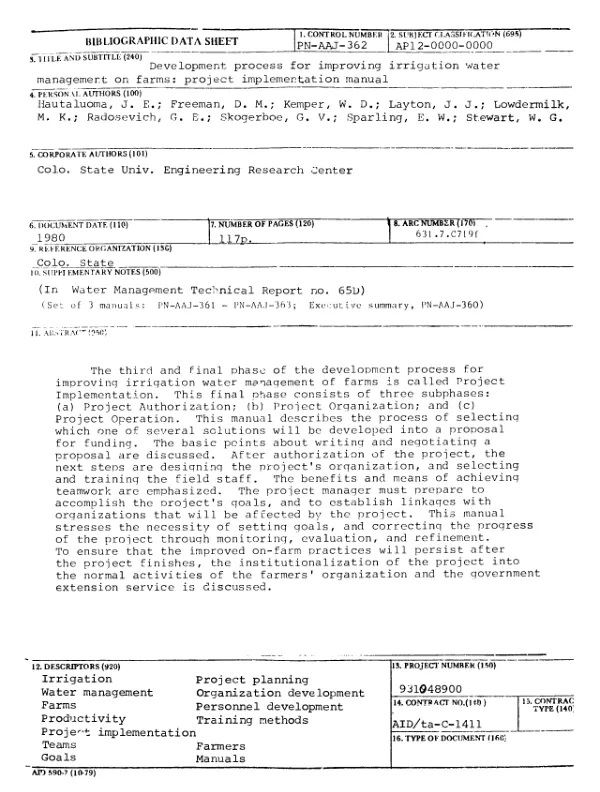
This volume, part of a four-volume series describing a comprehensive system for improving on-farm irrigation water management in developing countries, outlines a process for proposing and obtaining authorization of a project, establishing the project organization, and executing the project to meet its objectives. After reviewing and choosing from among previously identified and feasible solutions, the planner must conceptualize a set of objectives. This accomplished, a sound proposal must be prepared. It should describe a favorable impact on problems; contain new ideas and a review of current literature; be clear, concise, and complete; detail all planned operations; spell out the rights, duties, and responsibilities of all participants -- sponsors, farmers, and project staff; and be realistically budgeted. After authorization, the focus shifts to developing a strong project organization. This entails choosing an organizational design; selecting primary personnel -- project manager, technical field leaders, and support staff; selecting and training on-line personnel -- agronomists, engineers, and social scientists; refining objectives; establishing ties with farmer associations, the agribusiness community, the Ministry of Agriculture, national and international banks, etc.; and specifying project management (i.e., participative vs. authoritative). Operating the project to ensure objectives are met involves establishing a work plan and schedule of events, initiating field operations, establishing field technical support, training farmers, monitoring and evaluating progress, refining the project, and ultimately transferring responsibility for the project to local participants. In addition, long-run project success depends upon adequate farmer participation to ensure that project innovations are integrated into the local agricultural system. A l3-item bibliography (l958-80) is appended.