USAID. MISSION TO DOMINICAN REPUBLIC
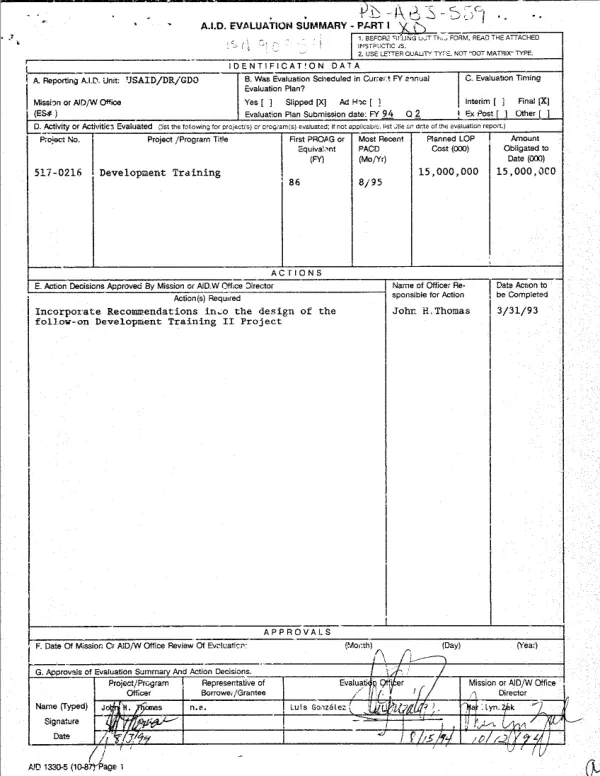
Development training
Project to train professional, managerial, and technical personnel in the Dominican Republic in priority, export-oriented, private sector areas.
1986
Sign in to readA free account is required to download.
Abstract
The project, which will provide both graduate and short-term training, will be implemented by the National Council of Businessmen (CNHE), a nonprofit Dominican organization. Project training will be provided mostly in the United States, although some will be in third countries, and will be in areas related to export promotion in the industrial, agricultural, agro-industrial, and financial sectors. Four types of participant training will be funded. (1) Master"s training will be provided to some 55 mid-level private sector employees. (2) Doctoral or Master"s training will be provided to eight faculty members from the Technological Institute of Santo Domingo, Pedre Henriquez Urena National University, and Central University, each of which offers graduate training in specialties needed by the private sector. Following training, these faculty members will assist their universities in upgrading programs in their respective fields. (3) Short-term training (e.g., short courses, seminars, study tours, formal courses, internships) will be provided for about 250 private sector employees, managers, or owners. The training will be tailored to specific job, enterprise, and/or private sector needs. Group training programs will also be designed to respond to sector- or area-specific training needs. (4) Partners of the Americas, under a subgrant agreement with CNHE, will arrange a tailored course of U.S. study and observational visits for a minimum of four Master"s and 30 short-term trainees. Finally, supportive activities such as English-language training, special programming (e.g., educational counseling, orientation programs), enrichment and exit programs, and student follow-up will be implemented. Amendment of 8/24/88 more than doubles project funding in order to expand training to cover needs not currently met by USAID/DR projects. Priority areas, in addition to export promotion, will include health, social services, and public sector areas that affect private sector-led growth. New project elements include: Masters level training of 70 private sector employees and selected areas of the public sector; short-term training of 275 public and private sector employees; and in-country training of 2,000 persons. A new implementing agency, the Educational Credit Foundation of Action for Education and Culture (FUNDAPEC), will be added to handle public sector and nonprofit private sector training. (PD-AAY-122).
Related documents