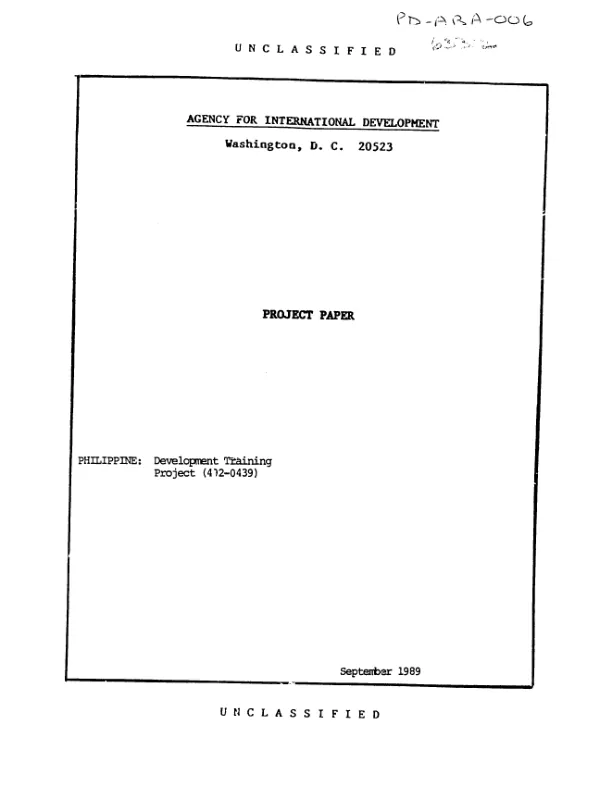
USAID. MISSION TO PHILIPPINES
Development training project
Project, follow-on to 4920340, to provide technical and managerial training in key development areas to private and public sector employees in the Philippines.
1989
Sign in to readA free account is required to download.
Abstract
The project, to be implemented primarily by the National Economic and Development Authority Scholarship Affairs Secretariat, will train 2,208 employees (571 public and 1,637 private sector). The public sector component will strengthen the institutional capacity of both local and national governments. To support the Philippines" decentralization program, about 60% of project funds for public sector training will finance management and technical training for local government (primarily provincial and municipal) personnel, including primarily in-country technical training of 397 persons and Master"s level training of 40 persons; these activities will be undertaken on a pilot basis in three regions (one from each of the major island groupings - Luzon, Visayas, and Mindanao), with the possibility of expanding to three additional regions. The remaining 40% of funds will finance management and analytical skills training for central and regional personnel; this will include in-country and U.S. academic training of 35 persons and technical training for 93 persons. (Third country training will be available to national and local personnel as appropriate.) Specific training areas will include, inter alia: economic policy analysis and planning, banking and finance, natural resource conservation, engineering, and public management specialties. Private sector training will target owners and employees of small to medium-sized rural, non-farm enterprises outside of the National Capital Region. (Micro-enterprises and cottage industries will not be targeted.) Training will also cover certain government-designated priority sectors (e.g., electronics, processed food and beverages, ceramics, and computer services). Both technical and managerial training will be provided in such areas as quality control systems, technology development, and packaging and labeling. Firms and/or trainees will be expected to contribute to costs of transportation and salary maintenance, and will be required to show that they are unable to finance direct training costs. All training will be short-term and non-academic. Nearly 1,400 persons will be trained in-country, 200 in the United States (for advanced technology training), and 37 in third countries.