USAID DEC
Digital Economy and Market Development Year 1 Monitoring Evaluation and Learning Plan
Sign inRESONANCE GLOBAL, LLC
Digital Economy and Market Development Year 1 Monitoring Evaluation and Learning Plan
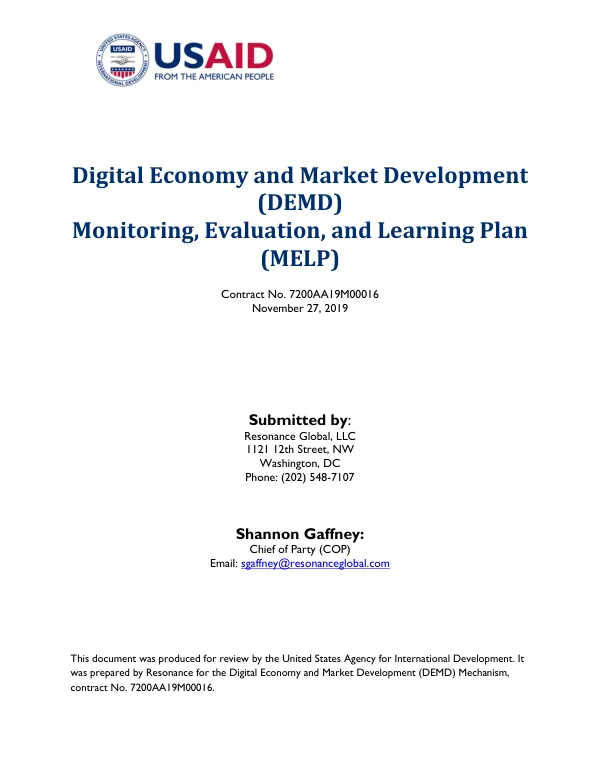
The Digital Economy and Market Development (DEMD) Monitoring, Evaluation, and Learning Plan (MELP) aims to facilitate learning for improved programming by collecting and analyzing performance data to evaluate overall project performance.
2019 · 34 pages
Sign in to readA free account is required to download.
Abstract
The DEMD MELP will employ a rigorous adaptive management approach to inform and improve project and task design over the course of DEMD implementation. This approach will involve iterative learning, collaboration, and adaptation to identify opportunities for improvement. The DEMD M&E system will have two primary roles: 1) to provide reliable, timely, and accurate data used to measure project performance and impact against targets and 2) to provide additional opportunities for insights and improvements through routine solicitation of client feedback, periodic data reviews, and interactive analysis. The DEMD M&E Specialist will be responsible for the operationalization of the MELP, including the establishment of all procedures and protocols related to the collection, validation, safe-guarding, processing, and use of performance data. Activity performance will be regularly monitored by tracking progress against selected indicators and their corresponding targets, where applicable. Output-level indicators measure the volume and frequency of DEMD tasks performed, such as the number of short-term technical assistance assignments fulfilled or the number of technical briefs created. Outcome-level indicators measure "next level" responses following provision of assistance by an Activity, tracking the use or impact of information or services provided by DEMD. The DEMD services that will be tallied under various output-level indicators include desk-based analysis, field-based analysis, assessment of program design, implementation, or impact, creation of diagnostic tools, provision of diagnostic tools for self-assessment, creation of training modules, provision of training modules, short-term assistance/STAS on sector-specific or cross-cutting issue, short-term assistance/STAS in program design, implementation, or impact, sector-specific bridging activities, gender and youth inclusion, monitoring, evaluation, and learning, creation of knowledge products, provision of knowledge products, facilitation of stakeholder engagement, dialogue platforms, working groups, evidence summits, online training tools and forums, webinars, and other stakeholder engagement tools. Outcome-level indicators will track the use or impact of information or services provided by DEMD, such as the application of training content or the improvement of programmatic results. These indicators will provide critical insight into the utility, ease of application, and sustainability of services provided. Outcome-level indicators can provide early warnings of program or intervention design flaws that need to be addressed, provided that they are designed to show client application or success rates. Any outcome rates that fall below 85% will immediately alert DEMD management to investigate the cause of the low score and modify the approach in order to address the issue. The DEMD will provide assistance within six primary service components: technical analysis and learning tools; rapid response and short-term assistance; stakeholder communications and knowledge management and generation; training; short-term assistance support; and monitoring and evaluation. For the purposes of the DEMD MELP, tasks and outcomes under short-term technical assistance and short-term activity support will be tracked and monitored to ensure that the services provided are effective and efficient. The DEMD MELP will provide a framework for monitoring and evaluating the performance of these services and making adjustments as needed to ensure that the project is meeting its goals and objectives.