USAID
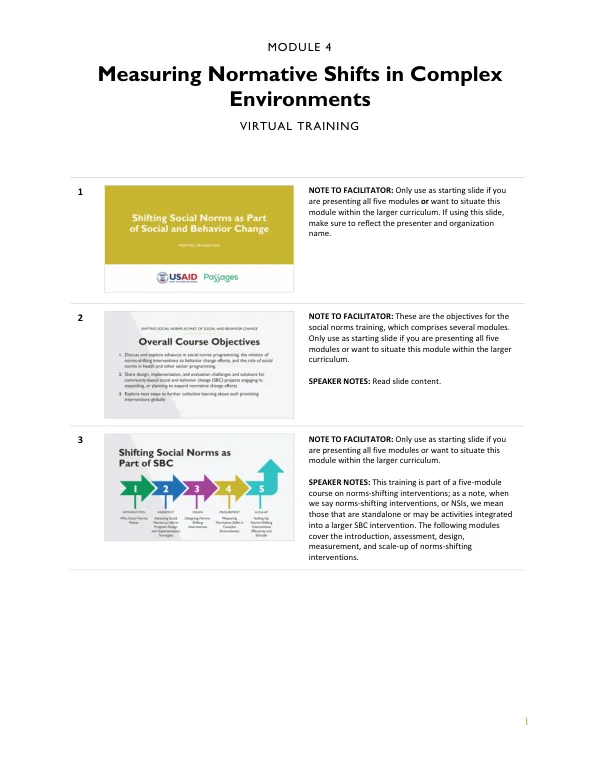
Measuring Normative Shifts in Complex Environments
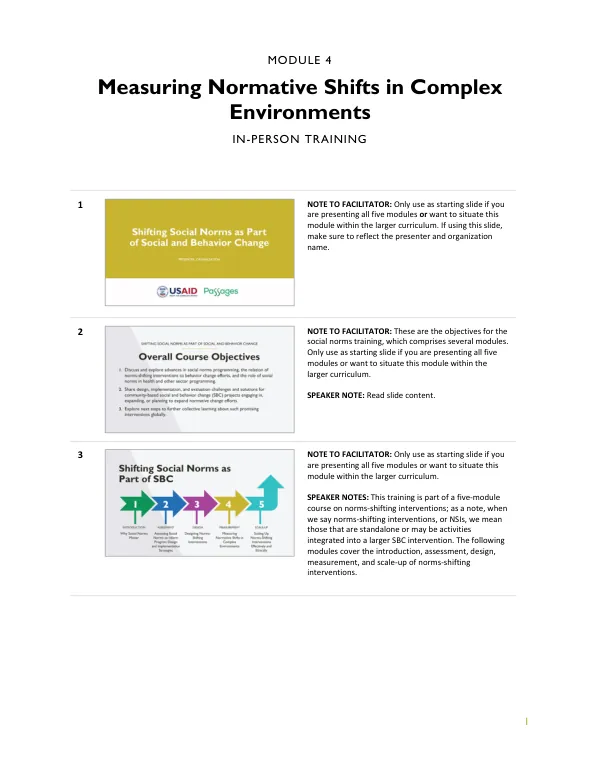
Measuring Normative Shifts in Complex Environments is a critical component of norms-shifting interventions (NSIs).
2022 · 28 pages
Sign in to readA free account is required to download.
Abstract
These interventions aim to change social norms and behaviors in communities, often in complex and dynamic environments. The module focuses on monitoring and evaluation (M&E) of NSIs, which differ from other projects due to the complex social systems they operate within. NSIs can lead to unexpected effects, including social opposition and new social possibilities for communities to explore. For example, after critical reflection on new ideas, communities may adopt a new normative idea, strongly oppose it, or exhibit both reactions simultaneously. These dynamics define how M&E of NSIs differ from other projects. The module provides an overview of M&E and examines strategies to gather and use information to improve NSI implementation in complex contexts. It discusses project monitoring and rapid studies, which provide a basis for learning and adaptive management of NSIs during implementation. Monitoring in complex social contexts implies looking for signs of norms change and addressing social pushback, opposition, or other unanticipated outcomes as they emerge. The module also focuses on the evaluation of normative shifts, moving to a discussion of measurement where quantitative and qualitative approaches to measure normative change resulting from NSI project implementation are examined. This includes assessing the impact of NSIs on social norms and behaviors, as well as evaluating the effectiveness of NSI strategies in achieving desired outcomes. Social norms are context-specific and defined in relation to a reference group, which is a group of influential people, individuals, or peer groups that sustain community beliefs around social norms. Reference groups can exert a considerable amount of influence on behavior and are considered community authorities or influential persons in a group. Power holders within reference groups have disproportionate influence on the behaviors and beliefs of a group. The lens of social behavior change (SBC) that is normatively focused emphasizes the importance of changing power dynamics in norms change. This involves understanding the power dynamics within a community and identifying the influencers of the target group. The SBC lens also highlights the importance of safe spaces and critical reflection in norms change. Monitoring and evaluation are critical components of NSIs, and they differ from other projects due to the complex social systems they operate within. Monitoring is a systematic and routine process of gathering information from different parts of a program, usually focused on short-term outcomes, and is generally conducted by people involved in the program. Evaluation, on the other hand, is an assessment of an entire program cycle, usually long-term, and is often conducted by impartial outsiders with M&E background. The module also discusses the influence of complex environments on project design, implementation, and evaluation. Complex systems operate in unpredictable ways, and unexpected outcomes will present themselves. Tailoring the approach to account for this complexity and paying attention to unintended outcomes is crucial for effective M&E of NSIs.