USAID DEC
Direct observation of respectful maternity care in five countries: a cross-sectional study of health facilities in East and Southern Africa
Sign inJOHNS HOPKINS UNIVERSITY BLOOMBERG SCHOOL OF PUBLIC HEALTH/INFO PROJECT
Direct observation of respectful maternity care in five countries: a cross-sectional study of health facilities in East and Southern Africa
Increasing access of pregnant women to skilled care during childbirth is a key strategy for reducing maternal and early neonatal mortality and morbidity.
2015 · 11 pages
Sign in to readA free account is required to download.
Abstract
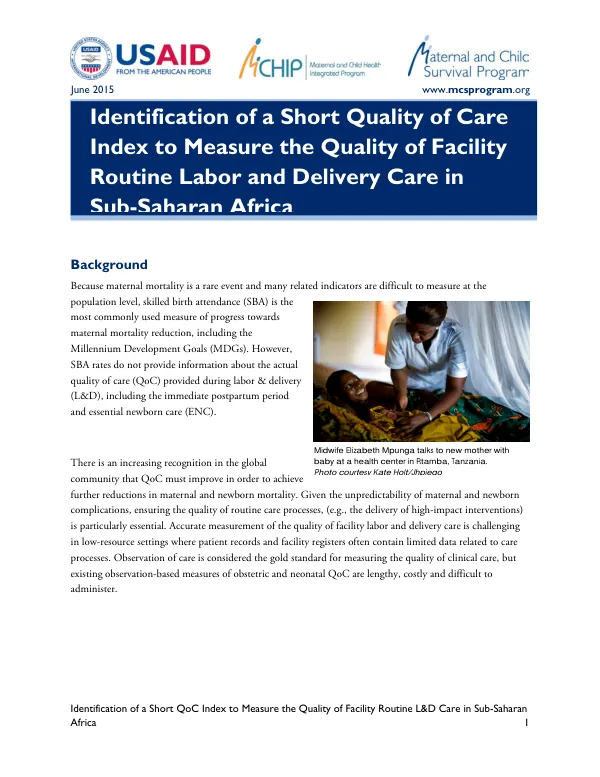
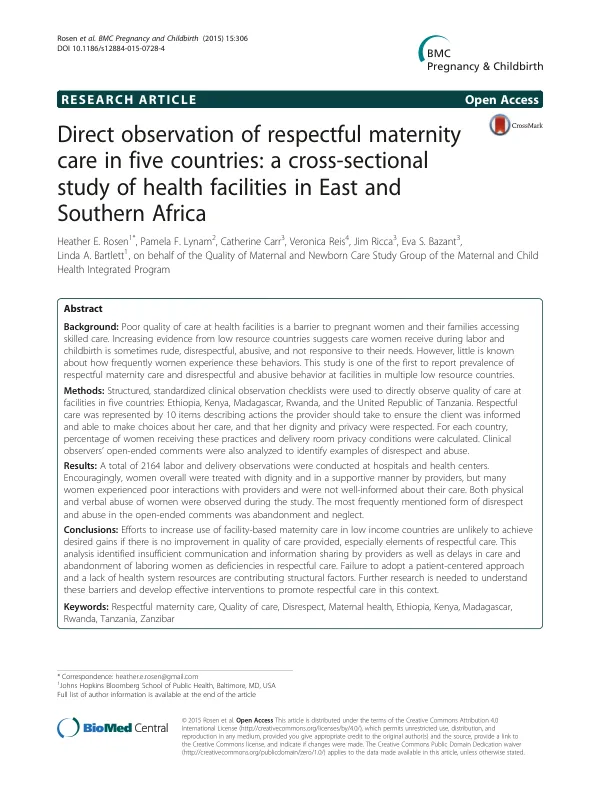
Most maternal deaths are considered preventable, and the majority could be averted by increased access to a skilled care provider supported by the resources of a functioning health system. Recent modeling of the effect of scaling up selected evidence-based interventions during facility-based labor and delivery confirms a 79% decrease in maternal deaths is possible. With the global agenda historically focused on increasing access, or quantity, of skilled care, the need to improve quality of care has received less attention. To save women's lives and improve maternal and newborn health, women must both come to the facility to give birth with a skilled health provider and receive high-quality care to prevent and address complications that may arise. Quality of care encompasses structure, processes of care, and outcomes. Structural elements include the presence of needed medicines, equipment, and provider training, while outcomes are changes in health status and patient satisfaction. Processes of care include both technical aspects, which is the delivery of clinical procedures and treatments, and the client-provider interpersonal relationship, including how information is shared and decisions about care are made. The personal interaction between client and provider is important in shaping women's experiences and their perceptions of maternity care. Poor interpersonal communication between client and provider during maternity care at health facilities in low-resource settings is increasingly recognized as a barrier to accessing skilled care for routine and complicated births. An increasingly cited framework for describing interpersonal aspects of care during childbirth is the seven domains of disrespect and abuse (D&A) outlined in Bowser and Hill's landscape evidence review: physical abuse; non-consented care; non-confidential care; non-dignified care; discrimination; abandonment of care; and detention in facilities. The White Ribbon Alliance subsequently published the Respectful Maternity Care Charter: The Universal Rights of Childbearing Women, grounded in international human rights instruments such as the Universal Declaration of Human Rights. The seven articles of the Charter are closely aligned to the seven domains of D&A. While these approaches are similar, the Charter frames the discussion in terms of positive, desired behaviors. The concept of respectful maternity care (RMC) acknowledges that women's experiences of childbirth are vital components of health care quality and that their "autonomy, dignity, feelings, choices, and preferences must be respected." RMC has commonalities with other efforts to refocus medical care away from a disease-oriented model which privileges the physician as expert, including patient-centered care and the humanization of childbirth. The seven rights of childbearing women from the Respectful Maternity Care Charter include the right to be free from harm and ill treatment, the right to information, informed consent, and respect for choices and preferences, the right to privacy and confidentiality, the right to be treated with dignity and respect, the right to equality, freedom from discrimination, and equitable care, the right to healthcare and the highest attainable level of health, and the right to liberty, autonomy, self-determination, and freedom from coercion. There is limited evidence on the prevalence of respectful care or D&A in facility-based maternity services delivered in low-resource settings. Neither routine health information systems nor facility assessments capture this type of data. Four recent studies in Kenya, Tanzania, Ethiopia, and Nigeria analyzed women's experiences during childbirth to estimate prevalence of disrespect and abuse, with reported rates ranging from 20% to 98%. This study aimed to provide a descriptive overview of the quality of respectful maternity care in diverse facility settings in East and Southern Africa. A total of 2164 labor and delivery observations were conducted at hospitals and health centers in five countries: Ethiopia, Kenya, Madagascar, Rwanda, and the United Republic of Tanzania. Encouragingly, women overall were treated with dignity and in a supportive manner by providers, but many women experienced poor interactions with providers and were not well-informed about their care. Both physical and verbal abuse of women were observed during the study. The most frequently mentioned form of disrespect and abuse in the open-ended comments was abandonment and neglect. Efforts to increase use of facility-based maternity care in low-income countries are unlikely to achieve desired gains if there is no improvement in quality of care provided, especially elements of respectful care. This analysis identified insufficient communication and information sharing by providers as well as delays in care and abandonment of laboring women as deficiencies in respectful care. Failure to adopt a patient-centered approach and a lack of health system resources are contributing structural factors. Further research is needed to understand these barriers and develop effective interventions to promote respectful care in this context.