USAID DEC
The Impact and Cost of Scaling up Midwifery and Obstetrics in 58 Low- and Middle-Income Countries
Sign inFUTURES INSTITUTE
The Impact and Cost of Scaling up Midwifery and Obstetrics in 58 Low- and Middle-Income Countries
Maternal and child mortality levels in many countries remain far from the United Nations Millennium Development Goals (MDGs).
2014 · 10 pages
Sign in to readA free account is required to download.
Abstract
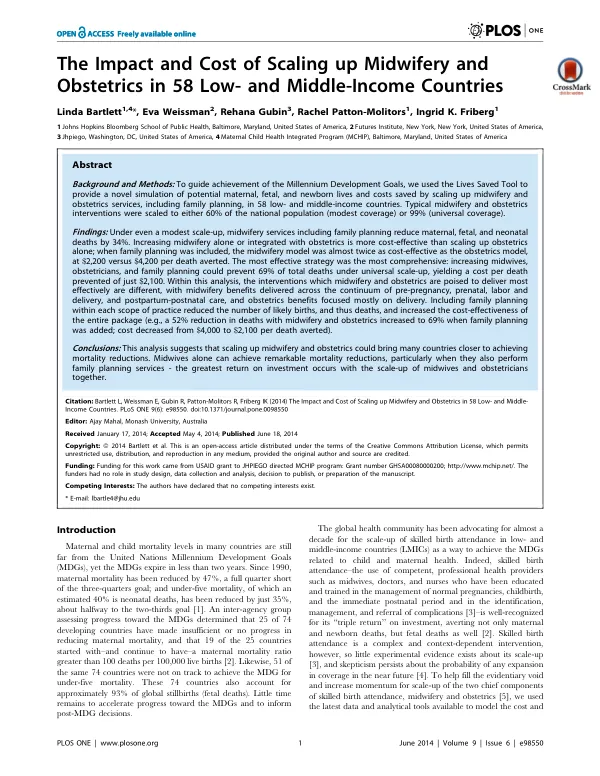
Despite a 47% reduction in maternal mortality since 1990, a full quarter short of the three-quarters goal, and a 35% reduction in under-five mortality, about halfway to the two-thirds goal, 25 of 74 developing countries have made insufficient or no progress in reducing maternal mortality. These countries account for approximately 93% of global stillbirths. The global health community has advocated for the scale-up of skilled birth attendance in low- and middle-income countries (LMICs) as a way to achieve the MDGs related to child and maternal health. Skilled birth attendance, which includes the use of competent, professional health providers such as midwives, doctors, and nurses, is well-recognized for its 'triple return' on investment, averting not only maternal and newborn deaths, but fetal deaths as well. To help fill the evidentiary void and increase momentum for scale-up of midwifery and obstetrics, a simulation was conducted using the Lives Saved Tool (LiST) to model the cost and mortality impact that could be achieved in the period from 2012 to 2015 under two different scale-up assumptions. The simulation included 58 countries included in the State of the World's Midwifery 2011 (SoWMy) report, with either maternal and newborn care (MNC) interventions alone or with MNC interventions plus family planning (FP). The LiST tool estimates the number of deaths averted by different health interventions, and was linked to midwifery and obstetric competencies and to cost estimates for intervention inputs. The analysis projected both the numbers of maternal, fetal, and neonatal lives that would be saved and the total costs of and costs per death averted through a scale-up of midwifery and obstetrics, stratified by coverage scale-up level, cadre, and initial basic emergency obstetric and newborn care (BEmONC) availability. The results of the simulation showed that under even a modest scale-up, midwifery services including family planning reduce maternal, fetal, and neonatal deaths by 34%. Increasing midwifery alone or integrated with obstetrics is more cost-effective than scaling up obstetrics alone; when family planning was included, the midwifery model was almost twice as cost-effective as the obstetrics model, at $2,200 versus $4,200 per death averted. The most effective strategy was the most comprehensive: increasing midwives, obstetricians, and family planning could prevent 69% of total deaths under universal scale-up, yielding a cost per death prevented of just $2,100. The analysis also showed that the interventions which midwifery and obstetrics are poised to deliver most effectively are different, with midwifery benefits delivered across the continuum of pre-pregnancy, prenatal, labor and delivery, and postpartum-postnatal care, and obstetrics benefits focused mostly on delivery. Including family planning within each scope of practice reduced the number of likely births, and thus deaths, and increased the cost-effectiveness of the entire package. The findings suggest that scaling up midwifery and obstetrics could bring many countries closer to achieving mortality reductions, and that midwives alone can achieve remarkable mortality reductions, particularly when they also perform family planning services.
Related documents
Documents in this collection
 2011
2011USAID DEC
U.S. Overseas Loans and Grants: Obligations and Loan Authorizations, July 1, 1945 – September 30, 2011
Open record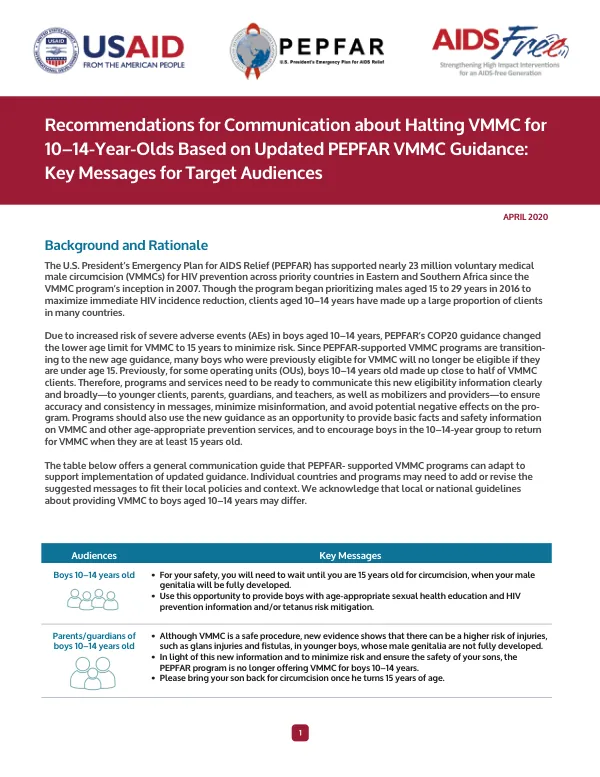 2020
2020USAID DEC
Recommendations for Communication about Halting VMMC for 10–14-Year-Olds Based on Updated PEPFAR VMMC Guidance: VMMC Key Messages for Target Audiences
Open record