JSI
Catalyzing Change: USAID & Maternal & Child Survival Program Year 1 Annual Summary
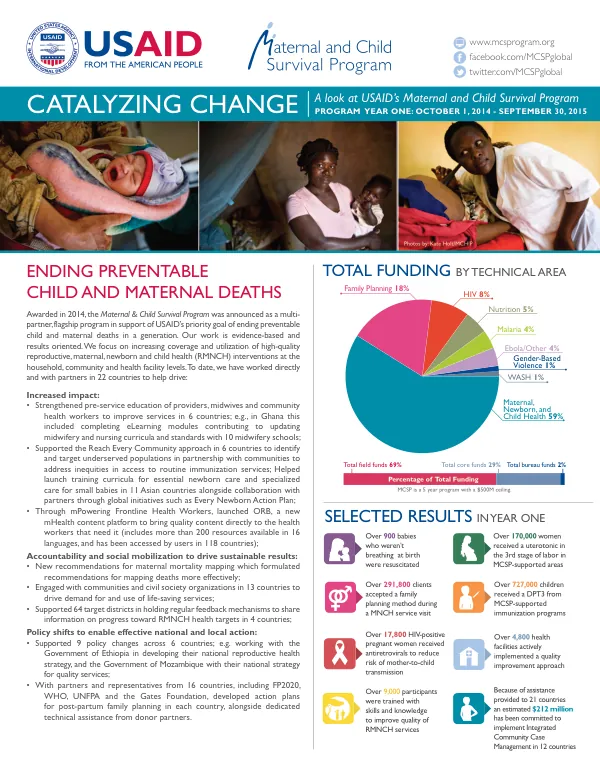
The Maternal and Child Survival Program (MCSP) was a five-year initiative launched in 2014 to increase maternal and child survival and build resilient, accountable, and responsive health systems in 32 countries.
2019 · 2 pages
Sign in to readA free account is required to download.
Abstract
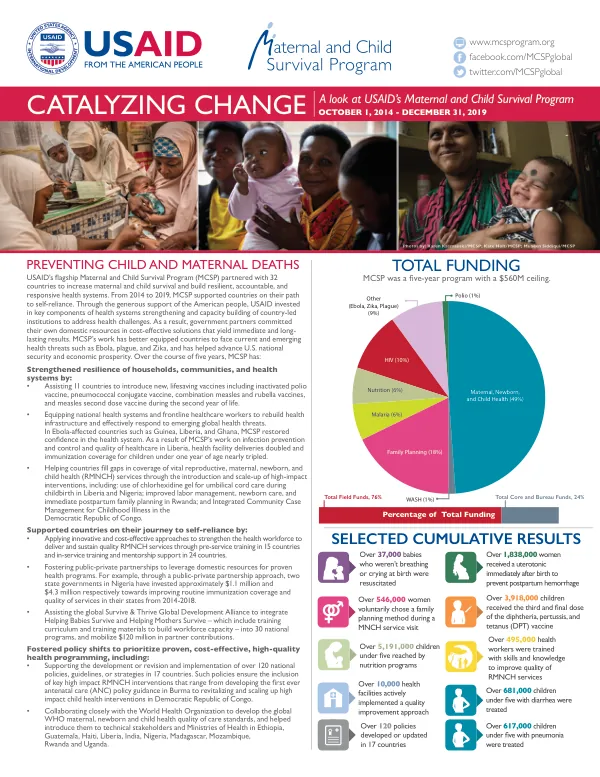
MCSP was a flagship program of the United States Agency for International Development (USAID) and was supported by the American people. The program aimed to strengthen the resilience of households, communities, and health systems to address health challenges and ultimately prevent child and maternal deaths. MCSP's work focused on several key areas, including the introduction of new, lifesaving vaccines, equipping national health systems and frontline healthcare workers to respond to emerging global health threats, and helping countries fill gaps in coverage of vital reproductive, maternal, newborn, and child health (RMNCH) services. The program also supported countries on their journey to self-reliance by applying innovative and cost-effective approaches to strengthen the health workforce and foster public-private partnerships to leverage domestic resources for proven health programs. Through its programming, MCSP achieved significant results, including the introduction of new vaccines in 11 countries, the restoration of confidence in the health system in Ebola-affected countries, and the improvement of labor management, newborn care, and immediate postpartum family planning in Rwanda. The program also supported the development or revision and implementation of over 120 national policies, guidelines, or strategies in 17 countries, and collaborated closely with the World Health Organization to develop global maternal, newborn, and child health quality of care standards. MCSP's cumulative results over the five-year period included the resuscitation of over 37,000 babies who were not breathing or crying at birth, the provision of uterotonic medication to over 1.8 million women immediately after birth to prevent postpartum hemorrhage, and the voluntary use of family planning methods by over 546,000 women during a maternal and child health service visit. The program also trained over 495,000 health workers with skills and knowledge to improve the quality of RMNCH services, and reached over 5.1 million children under five with nutrition programs. MCSP's work was implemented in 32 countries, including Nigeria, Mali, Madagascar, Mozambique, Zambia, South Africa, the Democratic Republic of Congo, Ethiopia, India, Kenya, Tanzania, Uganda, Rwanda, Malawi, Ghana, Liberia, Namibia, Guinea, Burma, Nepal, Laos, Indonesia, Egypt, and others. The program was supported by a total of $560 million in funding, with 76% of the funds coming from field sources and 24% from core and bureau funds.
Related documents