USAID. MISSION TO SRI LANKA
Diversified agriculture research
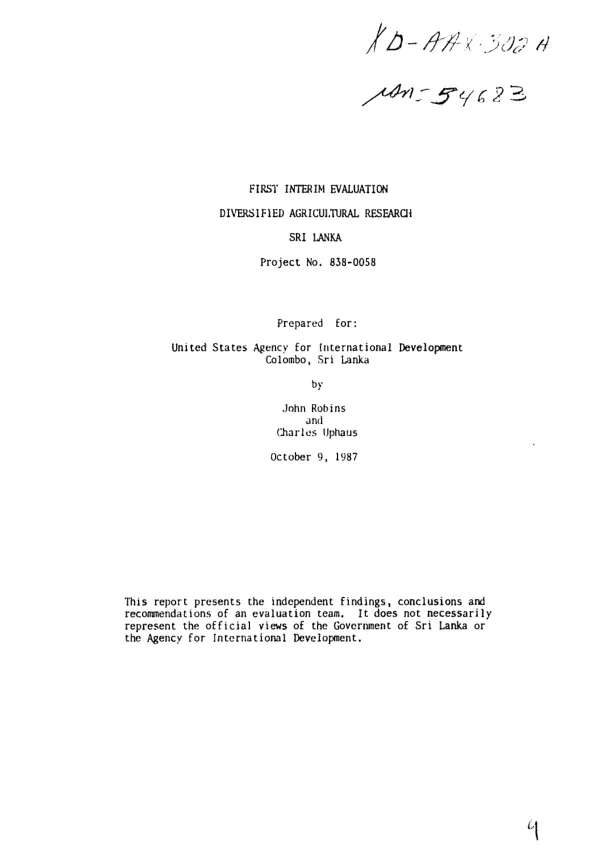
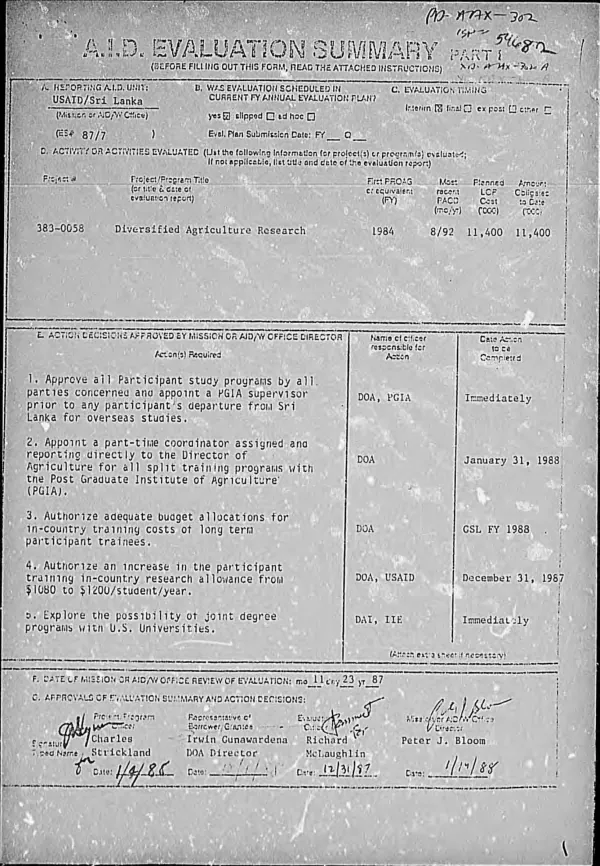
Summarizes attached external evaluation (XD-AAX-302-A) of a project to strengthen the capacity of the Sri Lankan Department of Agriculture (DOA) to generate and transfer technologies and seed needed to sustain small farm production of subsidiary field crops (SFC"s).
1988
Sign in to readA free account is required to download.
Abstract
Evaluation covered the period 8/84-9/87 and was based on document review, site visits, and interviews with all key personnel. Overall, implementation is good and no major changes are needed. Progress has been made in developing a successful commodity research program for SFC"s; in developing the seed component (especially in mobilizing support for privatization of the seed industry); and in matching short-term training to DOA needs. Management and coordination of the DOA/SFC program has been strengthened by the development, with the help of well-conceived socioeconomic studies, of a life-of-project workplan and annual updates. Additional study of the flow of technical and administrative information is required, however, as well as middle management training. The TA contractor, Development Alternatives, Inc., has generally performed very well, and the Institute for International Education has managed the training program satisfactorily. On the debit side, the farming systems research and extension component has lagged. The extension program has been hampered by an inadequate core budget, and project resources for mass media delivery have not been exploited. In addition, the project assumption that the demand for increased SFC production is unlimited has proven erroneous, while the original time-frame for planning construction and procuring commodities was wildly unrealistic. Finally, although the rationale for the long-term training "split degree" program (coupling non-degree academic programs at a U.S. or third-country university and in-country research, the degree being granted by the University of Peradeniya"s Post Graduate Institute of Agriculture) is sound, implementation problems -- relating to participant preparation and to research arrangements and allowances -- threaten the success of what is potentially the project"s most important component. Immediate remedial action is needed. The key lesson learned is that haste makes waste. In a complex project such as this, with many innovative components such as the split training program and with primary implementation responsibility devolving on the DOA, the project should learn to live with delays, rather than try to push things too fast. Fourteen action decisions are included.