USAID DEC
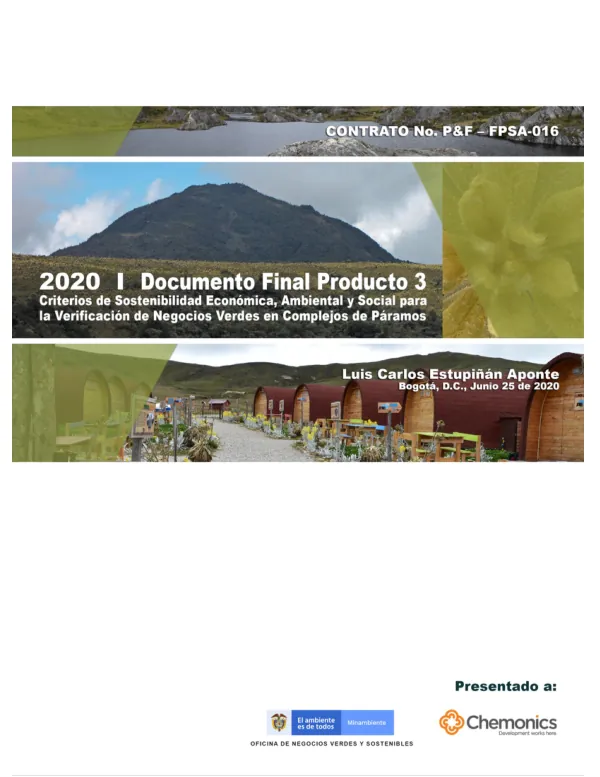
Documento de Criterios de Sostenibilidad Económica, Ambiental y Social para la Verificación de Negocios Verdes en Complejos de Páramos
Sign inDEUTSCHE GESELLSCHAFT FÜR INTERNATIONALE ZUSAMMENARBEIT GMBH
Documento de Criterios de Sostenibilidad Económica, Ambiental y Social para la Verificación de Negocios Verdes en Complejos de Páramos
The Colombian government has implemented a program to promote sustainable businesses in páramo and high mountain ecosystems.
2020 · 37 pages
Sign in to readA free account is required to download.
Abstract
The program, which began in 2014, aims to establish a framework for verifying the sustainability of businesses in these regions. The Ministry of Environment and Sustainable Development (Minambiente) has developed a tool to assess the sustainability of businesses, which includes 12 criteria in the economic, social, and environmental components. The tool, known as the "Herramienta de Verificación," has been used to evaluate over 1,400 businesses between 2014 and 2018. However, the program has identified the need to revise and update the tool to better suit the specific needs of páramo and high mountain ecosystems. The current tool does not take into account the unique characteristics of these ecosystems, such as the importance of water management and the need to protect biodiversity. To address this gap, the program has conducted a review of the existing tool and identified areas for improvement. The review has considered the following aspects: the current tool's limitations, the needs of businesses in páramo and high mountain ecosystems, and the requirements of the Colombian government's sustainability policies. The review has identified several key areas for improvement, including the need to incorporate more specific criteria related to water management, biodiversity conservation, and community engagement. The program has also identified the need to develop a more comprehensive framework for evaluating the sustainability of businesses in these regions. The Colombian government has established a set of criteria for verifying the sustainability of businesses in páramo and high mountain ecosystems. The criteria include aspects related to economic, social, and environmental sustainability. The criteria are as follows: * Economic sustainability: The business must demonstrate a positive economic impact on the local community, including job creation and income generation. * Social sustainability: The business must demonstrate a positive social impact on the local community, including community engagement and social responsibility. * Environmental sustainability: The business must demonstrate a positive environmental impact, including the conservation of biodiversity and the protection of natural resources. The program has also identified several key indicators for evaluating the sustainability of businesses in páramo and high mountain ecosystems. The indicators include: * Water management: The business must demonstrate effective water management practices, including the conservation of water resources and the protection of water sources. * Biodiversity conservation: The business must demonstrate a commitment to biodiversity conservation, including the protection of endangered species and the conservation of natural habitats. * Community engagement: The business must demonstrate a commitment to community engagement, including the involvement of local communities in decision-making processes and the provision of benefits to local communities. The program has also identified several key challenges and opportunities for promoting sustainable businesses in páramo and high mountain ecosystems. The challenges include: * Limited access to funding and resources for businesses in these regions. * Limited capacity and expertise among local businesses and communities to implement sustainable practices. * Limited awareness and understanding of the importance of sustainability among local businesses and communities. The opportunities include: * The potential for businesses in these regions to generate significant economic benefits, including job creation and income generation. * The potential for businesses in these regions to contribute to the conservation of biodiversity and the protection of natural resources. * The potential for businesses in these regions to promote community engagement and social responsibility. The program has made several recommendations for promoting sustainable businesses in páramo and high mountain ecosystems. The recommendations include: * The development of a more comprehensive framework for evaluating the sustainability of businesses in these regions. * The provision of training and capacity-building programs for local businesses and communities to implement sustainable practices. * The provision of funding and resources for businesses in these regions to support the implementation of sustainable practices. The program has also identified several key stakeholders who will be involved in the implementation of the recommendations, including: * The Ministry of Environment and Sustainable Development (Minambiente). * The Colombian government. * Local businesses and communities. * International organizations and NGOs. The program has also established a set of indicators for monitoring and evaluating the effectiveness of the recommendations. The indicators include: * The number of businesses in páramo and high mountain ecosystems that have implemented sustainable practices. * The level of community engagement and social responsibility among local businesses and communities. * The level of biodiversity conservation and natural resource protection among local businesses and communities. The program has
Related documents