USAID DEC
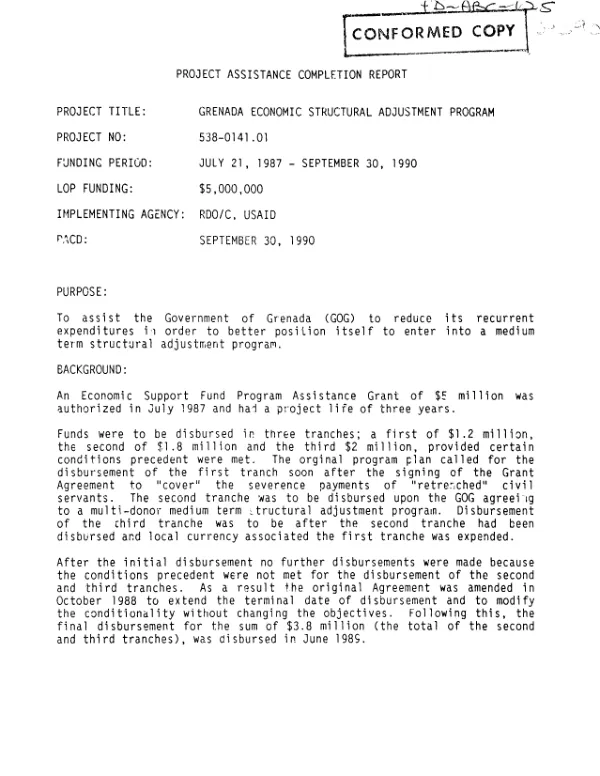
Project assistance completion report : Grenada economic structural adjustment program
Sign inUSAID. BUR. FOR LATIN AMERICA AND THE CARIBBEAN. REGIONAL DEVELOPMENT OFC.
Project assistance completion report : Grenada economic structural adjustment program
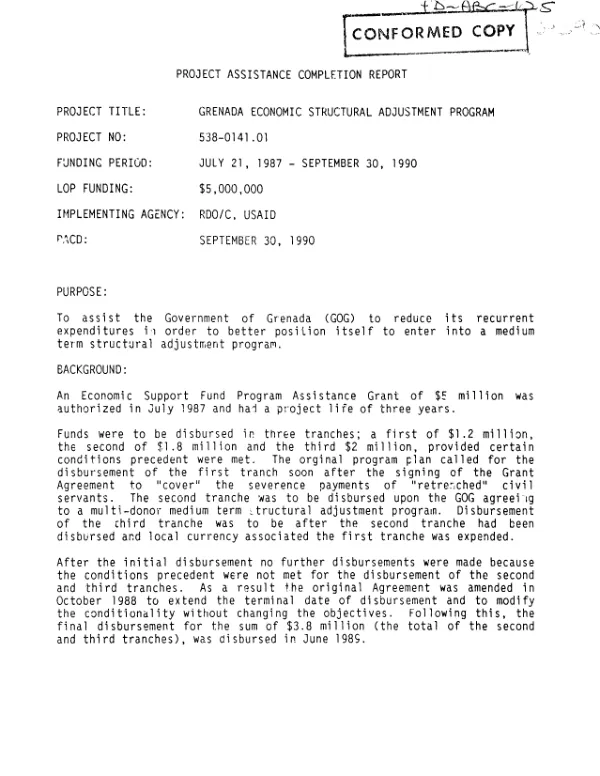
PACR of a program (7/87-9/90) to provide a $5 million cash transfer to the Government of Grenada (GOG) in support of economic policy reform.
1990
Sign in to readA free account is required to download.
Abstract
The program's original goal was to encourage the GOG to participate in a multi-donor structural adjustment program. When this effort failed, A.I.D. became the major supporter of GOG policy reform, which entailed a drastic, rapid overhaul of the existing tax system. While the reform succeeded in reducing the deficit and raising needed revenue, the economic benefits of the new taxes were not fully achieved because of structural and implementation problems. Personnel to implement the new value- added tax (VAT) were insufficient and inadequately trained, and continual changes in VAT regulations and procedures created confusion and uncertainty in the private sector. Private investment and construction activity flourished, but further development was hindered by the lack of coherence and continuity in tax policies. The VAT allowed higher income individuals and corporations to pay less taxes on their incomes, while lower income groups, previously exempt from taxation, were now taxed. However, this effect was somewhat compensated by increases in welfare and income levels for all income groups, and there is no evidence that the program caused undue hardship to the poor. The program also implemented a plan to reduce the fiscal deficit by requiring a 25% retrenchment of public service personnel. The plan backfired when skilled and senior personnel voluntarily departed, taking with them large severance payments. With the departure of these key personnel, replacements had to be found, so retrenchment and recruitment were operating concurrently, overburdening the GOG administration. The retrenchment plan proved demoralizing to staff and created social and political instability. It was discontinued after only 6% of public service personnel had been retrenched. Several lessons were learned. (1) A traditional VAT system is unlikely to succeed where tax administration is weak and proper accounting records are not available. (2) Staff education and the mobilization of public support for policy reforms are critical to success. (3) A phased and sequential technique is a better approach than a major overhaul of a tax system. (4) Multi-donor support is preferable to U.S. bilateral assistance. (5) A.I.D. should not assume that developing countries share its belief in the efficiency of the private sector. (6) When A.I.D. is a major donor, it should guard against instilling a client- state mentality of dependency in the recipient country. (7) Institution and policy development projects should be extended to 6-10 years. (8) Frequent changes in A.I.D./W's local currency guidance made it difficult to ensure that the program met all requirements.