UNIVERSITY OF ARIZONA. COLLEGE OF AGRICULTURE. OFC. OF ARID LANDS STUDIES
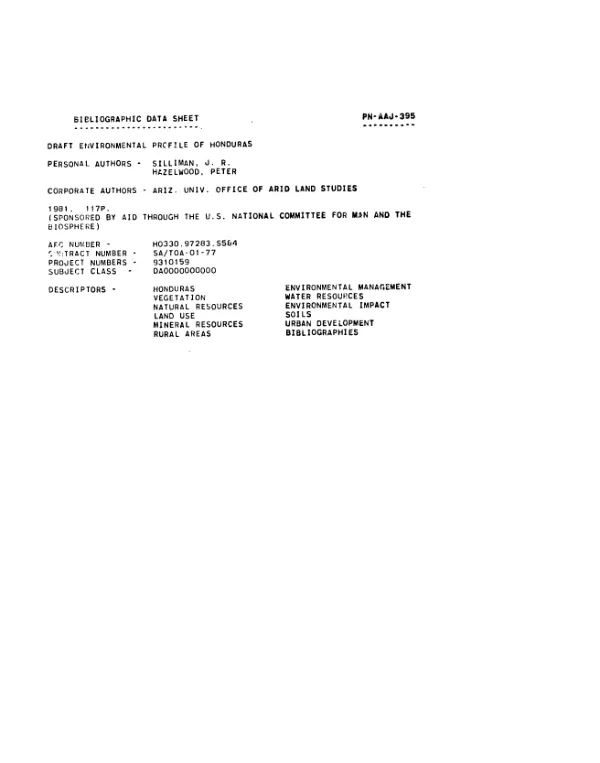
Draft environmental profile of Honduras
Honduras suffers from major environmental problems which, due to the increasing exploitation of marginal lands by a rapidly expanding population and the implementation of more ambitious natural resource exploitation programs, are currently reaching crisis proportions.
Silliman, J. R.; Hazelwood, Peter. T. · 1970
Sign in to readA free account is required to download.
Abstract
So concludes this report on the country"s environment and natural resources. Against background descriptions of the Honduran geography, climate, population, and land use, the study outlines the country"s environmental resources (geologic and soil, water, and flora and fauna) and current conservation measures and details major problem areas. The country"s main environmental problem is soil erosion and loss of soil fertility due to uncontrolled agricultural settlement and the widespread use of traditional slash and burn cultivation systems by small farmers emigrating to increasingly marginal and sloping lands. In addition, alluvial and valley soils best suited to intensive cultivation are frequently used for less productive and less labor-intensive pastureland. If forest resource depletion - caused by major lumber and pulp cutting projects, increased use of timber among rural populations for fuel, and accelerated clearings for agricultural development - continues at its current (1980) annual rate of 60,000 ha, forest resources will be completely exhausted by the year 2000. Other environmental problems are the unintentional results of rural and urban development. Although not widespread in Honduras, problems associated with the indiscriminate use of agricultural pesticides such as human and animal poisoning and malaria, have been discovered in neighboring countries. Surface water contamination leading to contagion of disease through drinking water plagues Tegucigalpa and threatens other urban and semi-urban areas having inadequate sewage and water treatment systems. To help preserve remaining resources, the authors recommend establishing a national policy to manage and control land use; reserving land tracts for prioritized land uses; and enforcing current environmental law. Appendices include a summary of Honduran environmental law and policy and a 111-item bibiliography (1927-80) in English and Spanish.
Related documents