UNIVERSITY OF ARIZONA. COLLEGE OF AGRICULTURE. OFC. OF ARID LANDS STUDIES
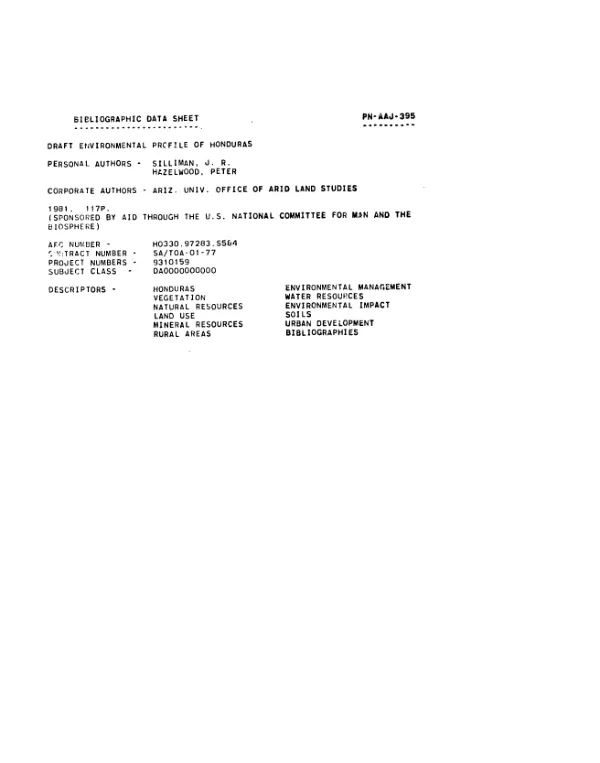
Draft Environmental Report on Cape Verde
The Cape Verde Islands currently suffer from soil degradation, improper land usage, and shortages of fuel and water.
1970
Sign in to readA free account is required to download.
Abstract
Such are the conclusions of this draft report which profiles the natural resources of these 10 islands and five islets, and provides related geographical, climatic, land use, and population data. Cape Verde"s steep watersheds, torrential rains, rapid water runoff, and strong winds cause extensive soil erosion. The inhabitants add to the problem by removing natural vegetation (often by the roots) for fuel, construction, agricultural extension, and intensive livestock feeding. Since 1976, construction to modify slopes and stream gradients has included earth or stone-walled terraces, contour ditches to slow water runoff, and check-dams for streams. Regeneration of rangelands requires protection from livestock and, to restore soil organic matter, the planting of windbreaks and "green-manure" crops. Proper land usage, increased food production, and the cessation of environmentally harmful forms of farming require crop diversification, wider area irrigation, fertilizer and pesticide usage, and better grain storage facilities. To minimize soil erosion and vegetation loss, the intensive cultivation of steep and arid areas must end -- even if this requires relocating current residents. Fuelwood demand drains the land and vegetation considerably, while imported fuels are too costly for rural residents. To effectively end the fuel shortage, Cape Verde must develop alternative energy sources such as windpower, biogas, and solar and geothermal energy. The scarcity of water is due to erratic or nonexistent rainfall; terrain that is unsuitable for reservoirs and conducive to runoff; and groundwater sources that are hard to locate because of the islands" volcanic formations. Water supplies can be increased by better surface water storage, slowing water runoff, and by inducing artificial recharge and increasing drilling of groundwater sources. Also needed to end the shortage are greater water usage efficiency, especially in irrigation, and improved survey information for water source exploitation. Appended is an 81-item bibliography (1935-80) in French, English, German, and Portuguese.