UNIVERSITY OF ARIZONA. COLLEGE OF AGRICULTURE. OFC. OF ARID LANDS STUDIES
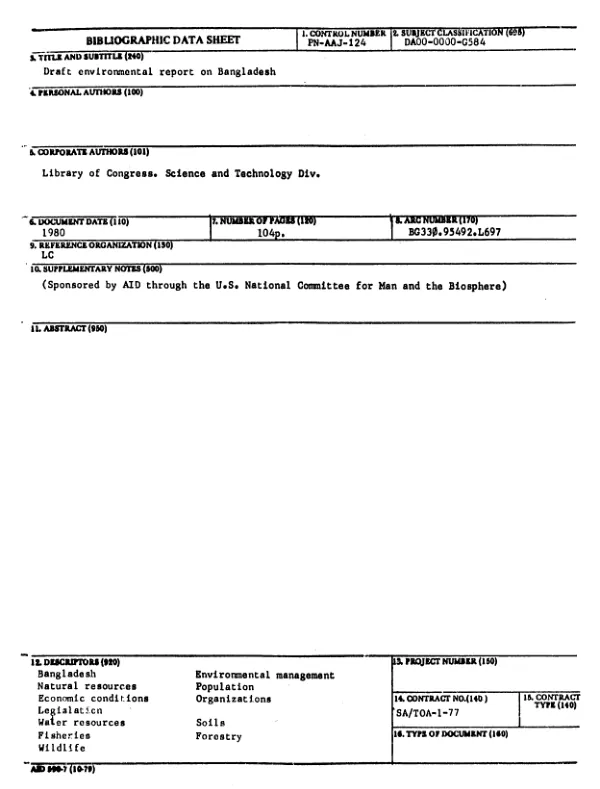
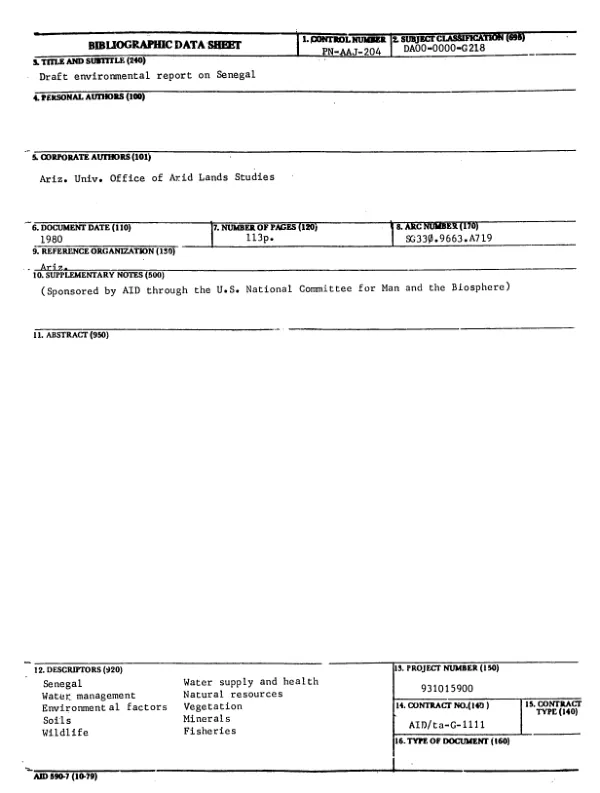
Draft Environmental Report on Senegal
Senegal"s slow response to rapid economic, social, and technological changes has led to several environmental problems.
1970
Sign in to readA free account is required to download.
Abstract
This draft report focuses on these issues while profiling the nation"s natural resources of water, soils, vegetation, wildlife, minerals, and protected areas. The relationships of these resources to enterprises such as agriculture, fisheries, pastoralism, and fuelwood production are highlighted in terms of the country"s geographical and social characteristics, economy, and political structure. The following environmental problems are evident: (1) A quarter of Senegal"s territory is arid and 70% is semiarid. Desertification is widespread, particularly in the northern part of the Fleuve region, Senegal Oriental, the eastern central zone of Casamance, and the Cap Vert region. Uncontrolled grazing, inadequate control of forest exploitation for fuelwood and coal, accidental and agricultural brushfires, and the abandonment of farmland due to loss of soil fertility all contribute to this erosive process. (2) Inadequate management of water resources has caused fluctuations in the productivity of the agricultural, livestock and forestry sectors. In the next 40 years, 13 dams will be built, providing electrical power and aid to irrigation which should raise cereal production five-fold. Unfortunately, much of the country will not benefit from these efforts and will continue to suffer from limited water supplies. (3) Most water supplies are polluted. In 1975, only 37% of the population had access to a safe supply of potable water. Water-related diseases, including malaria, onchocerciasis (which prevents the establishment of permanent farming communities in the fertile river bottoms), and diseases related to fecal contamination are serious health threats. (4) Population concentrations in the relatively developed Cap Vert region have led to the loss of rural productivity on which the country"s development depends. (5) Growing urbanization has accelerated air and water pollution. Appended are lists of domestic and foreign environmental organizations, current and proposed counter-desertification activities, and a 180-item bibliography (1953-79) in English and French.
Related documents