USAID
Draft GMI Work plan
The Commercial Village Stores Establishment project, implemented by Farm Concern International and USAID/COMPETE, aimed to improve grain handling, storage, and market opportunities in Jinja, Uganda, and Meru, Kenya.
2011 · 16 pages
Sign in to readA free account is required to download.
Abstract
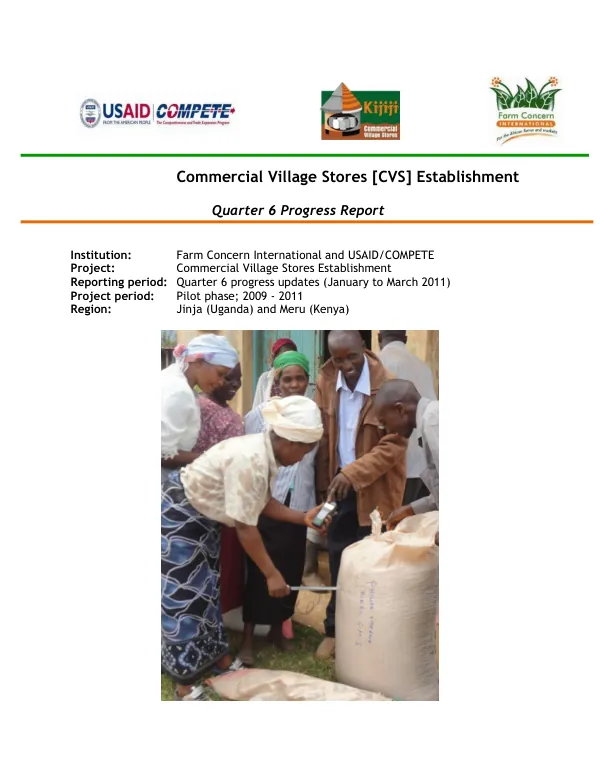
The project's quarter 6 progress report highlights key activities and achievements from January to March 2011. Training of trainers (ToTs) and community technical farmers (COTEFs) was a primary focus of the project. In Meru, 24 ToTs were trained between February 21-22, 2011, on topics including commercial village models, production, agro-inputs, marketing, storage, and mycotoxins. The ToTs were drawn from stakeholders and project partners, including the Ministry of Agriculture, agro-input dealers, and community-based organizations. A total of 90 COTEFs were trained in Meru, with 26 trained in Tigania West, 25 in Tigania East, and 34 in Imenti South. In Jinja, the ToT and COTEF training was conducted from March 8-12, 2011, with 24 ToTs trained and 93 COTEFs trained in the three sub-counties. The COTEFs were mainly lead farmers at the grassroots level. The intensive training programs aimed to boost technical support at the village level, where there is limited personnel under the Ministry of Agriculture and other private sector players. The project also focused on equipping store personnel with skills to improve grain handling and storage practices. A total of 16 stores were identified in Jinja during the quarter under review, with 4 stores being renovated by Farm Concern International. The project staff were trained on monitoring and evaluation by the COMPETE team, which equipped them with project M&E tools and key reporting requirements. Farmers were sensitized on the need to use certified seeds appropriate for their production zones to ensure good harvests. Linkages to agro-dealers who stock fertilizers and seeds were established to ensure farmers get the inputs at lower prices and in good time. Farmers also benefited from government-subsidized inputs from the National Cereals and Produce Board. Bulking of grains is ongoing in Meru, with a focus on enhanced household storage facilities. However, bulking has been constrained by low yields experienced in the previous season due to crop failure as a result of drought. The project achieved several milestones, including the establishment of 16 stores in Jinja, with 4 stores under renovation. Three stores were established in Jinja district, with a capacity to store 1,800, 10,000, and 1,800 bags, respectively. In Meru, 19.8 tonnes of grains were bulked, and store branding and identification are ongoing. The project also conducted trainings on collective marketing, post-harvest, and quality management. In Jinja, 500 farmers from community producer groups (CPGs) were trained on storage and quality control. In Tigania West, focus group discussions on quality maintenance were conducted, and three different demonstrations were conducted at CV level, with 254 farmers demonstrated on good farming practices, grain handling during post-harvest management, and store management. In Tharaka, 48 CPGs representatives were trained, and 2 Ministry of Agriculture officers attended the training. The trainings generated interest for more information from farmers on best storage practices. In Imenti South, four trainings on post-harvest and quality management were organized, and 458 farmers were trained on collective marketing and the effects of mycotoxins on stored produce. The project also conducted training workshops for COTEFs, with 91 COTEFs trained in Jinja and 17 COTEFs trained in Tharaka South-Tunyai. The COTEFs have been instrumental in carrying out community mobilization and awareness and offering technical support for farmers in the project sites.