USAID DEC
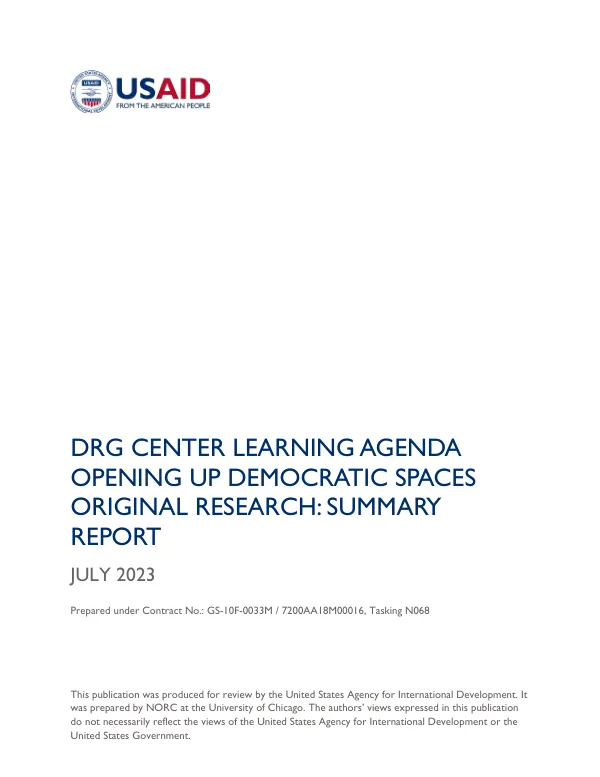
DRG Center Learning Agenda Opening Up Democratic Spaces Original Research: Summary Report
Sign inCORNELL UNIVARSITY INTERNATIONAL
DRG Center Learning Agenda Opening Up Democratic Spaces Original Research: Summary Report
The erosion of democratic governance in a significant number of countries over the past two decades has become a major source of debate among scholars and policymakers alike.
2023 · 20 pages
Sign in to readA free account is required to download.
Abstract
This original research examines the nature and sources of democratic "backsliding," and identifies potential strategies to enhance the resilience of democratic norms, practices, and institutions where they are threatened by autocratic forces. In contrast to military coups, insurgent takeovers, and other, more abrupt forms of democratic "breakdown," processes of contemporary democratic backsliding are notable for their gradual or incremental character and the central role played by actors within democratic institutions themselves—particularly, elected officeholders. Under backsliding, incumbents subvert democracy from within, using democratic institutions themselves to concentrate powers and dismantle regime checks and balances. Although complete democratic breakdowns have been concentrated in countries at lower levels of economic development, processes of backsliding are identifiable in high and low-income countries alike. Backsliding may be both a cause and an effect of political polarization—the division of the political sphere into mutually antagonistic "Us vs. Them" camps, and the resulting drive to tilt the democratic playing field to empower one camp while excluding the other. Polarization is often associated with the rise of populist leaders who capitalize on societal discontents to mobilize mass constituencies against established elites. This report summarizes the results of case studies of 15 countries that have experienced a process of democratic backsliding since the year 2000, with analysis of the opportunities for opening democratic spaces in these contexts. A key finding is that in most of these countries (13/15), democratic backsliding was attributable mainly to the efforts of elected executive branch leaders, sometimes in collusion with allied actors, to concentrate powers and weaken or eliminate legislative and judicial checks on their authority. They were, therefore, cases of executive aggrandizement (Bermeo 2016), with varying degrees of success. The 15 case studies are grouped into three categories, each with countries drawn from different world regions. The first category, Backsliding and Recovery, includes countries that experienced a process of backsliding, followed by a partial or complete recovery of democratic checks and balances. This category includes Brazil, Ecuador, Malawi, and Moldova, all cases of executive-led backsliding, and South Korea, a case of reciprocal backsliding. The second category, Partial Backsliding, includes countries that experienced an intermediate level of backsliding without either recovery or continued decline. They are, then, countries where a backsliding process has caused democracy to erode, but not break down or transition to autocracy. This category includes India and Poland as cases of executive-led backsliding, along with Indonesia, a case of elite collusion and power-sharing. The third category, Severe Backsliding, includes countries where severe and continuous backsliding culminated in a process of regime change from democracy to autocracy. In some cases, this process was facilitated by the actions of newly elected presidents who decreed popular referendums to bypass opposition-controlled legislatures, elect new constitutional assemblies, and re-found regime institutions more amenable to their control. Opportunities for opening democratic spaces occur across all forms and degrees of democratic backsliding, although with different expectations for the extent of democratic opening and with some clear patterns according to the degree and time of backsliding experienced. In cases of democratic recovery, aspiring executive autocrats were blocked by electoral opposition political party coalitions, the autonomy of courts, the fragility of their own ruling coalitions, and/or media oversight and civil society mobilization often including popular protest.