USAID. MISSION TO PERU
Upper Huallaga area development
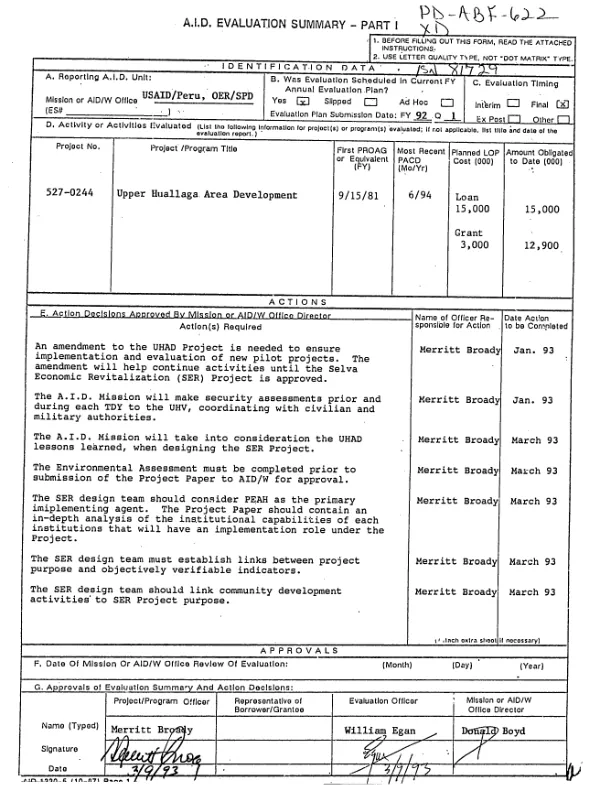
Summarizes final evaluation (XD-ABF-622-A) of a project to develop alternative agricultural production in Peru"s Upper Huallaga region, as part of an overall effort to minimize the impacts of coca eradication.
1993
Sign in to readA free account is required to download.
Abstract
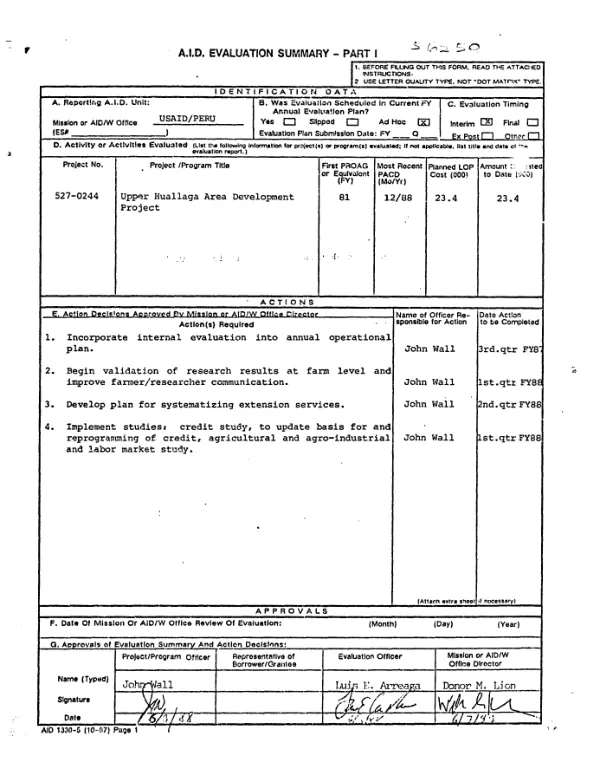
Evaluation covers the period 1982- 9/92. The project faced tremendous difficulties due to the often violent opposition of local farmers and others involved in coca production. This was especially the case between 1986 and 1990, when profit levels from coca production were at their highest. In 1988, the implementing agency, the Upper Huallaga Special Project (PEAH) was forced to reduce its range of activities and all contracted project TA was halted for security reasons. Infrastructure construction was hampered by difficult terrain, terrorist attacks, and worker strikes. The Ministry of Transport and Communications abandoned the project zone in 1985, but PEAH succeeded in upgrading 762 km of highway and 582 km of access roads (many of which, however, are now controlled by terrorists). The critical Marginal Highway, which connects the Huallaga Valley to Lima markets, was never completed. Lack of security also undermined agricultural research and extension efforts. Extensionists were unable to operate in the project zone, and extension and experimental stations were abandoned. Consequently, no viable agricultural production packages were produced. The credit component failed and programs were suspended. Institutional arrangements were not successful and farmers did not prove creditworthy. BANCOOP and BAP, the cooperative and agricultural banks, left the project zone by 1989 due to deteriorating security. PEAH attempted to disburse credit directly to farmers in 1990, but was unsuccessful due to its lack of experienced personnel. Although credit unions are being formed, it is doubtful that they will be viable. Land titling, a low priority aspect of the project, turned out to be its most dangerous. Land surveyors were murdered and property owners were forced to abandoned their farms. Moreover, there was virtually no demand for land titling. By 1992, only 815 titles had been issued to a target population of 300,000. Community development was the project"s only functioning element during the 1986-1989 period. In recognition of political realities, the project had begun, with tacit permission of terrorists, to work through local groups and organizations rather than public institutions. While community development cannot itself increase or diversify agricultural production, it has helped to create an environment which may have long-term beneficial impacts on the government"s ability to implement an alternative development program. The project can be viewed as a success because it was able to continue operations and to adapt to deteriorating security and the changing political environment. PEAH, as a result of its community development work, is now viewed positively by the local population. The project teaches several lessons of value for the follow-on Selva Economic Revitalization (SER) project (5270248), including the need for: easily trackable project management indicators, an environmental protection component, greater concentration on marketing, in-depth studies on credit and how it can be delivered, and more attention to the problem of security. Land titling should not be included if security is still a problem. In fact, SER activities should not be initiated unless security can be assured. The Mission notes that due to the constitutional coup in Peru, the SER project has been delayed and this project extended through 6/94. Several of the recommendations in the evaluation are being initiated as pilot efforts.
Related documents
Documents in this collection
 1992
1992USAID DEC
Lessons learned evaluation conducted for the Selva economic revitalization project, 527-0348, AID contract number LAC-0000-C-00-2005-00
Open record 1992
1992USAID DEC
![USAID/Peru strategic objective closeout report : USAID/Peru special objective -- "reduce illicit coca production in target areas in Peru" [SpO] 527-005](https://covers.devme.ai/gen/44205.webp)