USAID. MISSION TO PERU
Upper Huallaga area development project
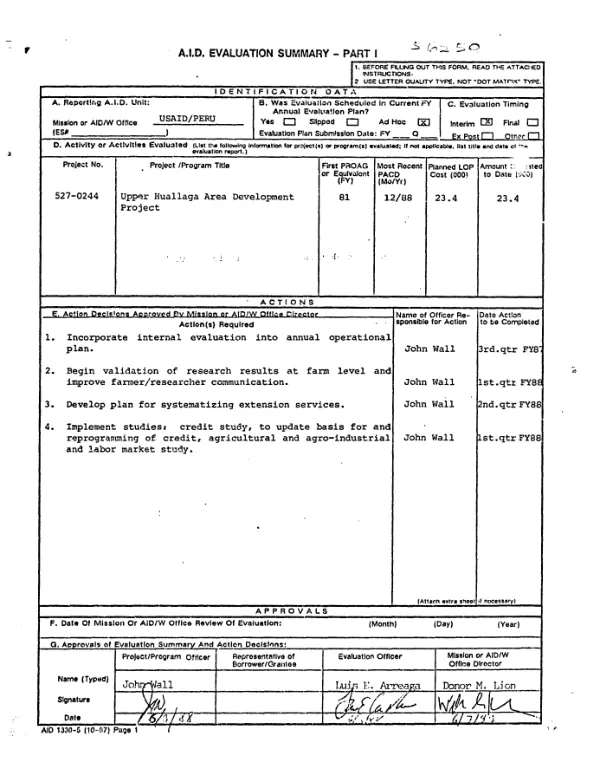
Summarizes attached evaluation of project to control coca leaf production in Peru"s Upper Huallaga (UH) region by supporting and diversifying legitimate agriculture (LA).
1988
Sign in to readA free account is required to download.
Abstract
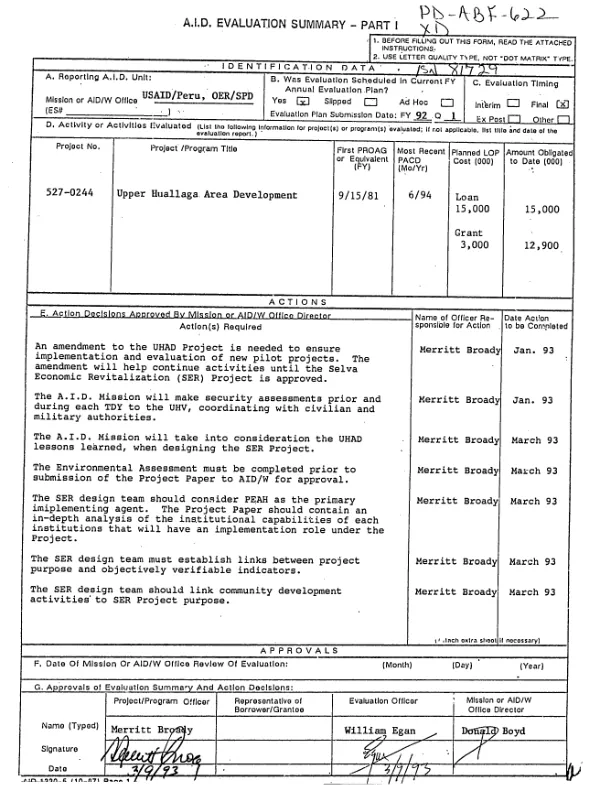
Interim evaluation covered 9/81-5/88 and was based on document review, site visits, and interviews with project staff and UH residents. A planned agricultural survey was not performed due to security risks. The project has made little progress toward its goals due to poor coordination among implementing agencies and violent opposition by the local population. Despite eradication efforts by the U.S./GOP-funded Rural Police Force (UMOPAR) and Coca Eradication Agency (CORAH), coca production still offers enormous economic advantages over LA. In most cases, farmers whose coca plantings have been eradicated have simply moved to other areas and continued the practice. The project has succeeded in making agricultural services available in UH, but due in part to the deteriorated security situation, LA has remained stagnant while coca production has increased. Agricultural research is being carried out, but needs to be focused on developing new higher yielding, disease resistant crops to increase the economic viability of LA. An agricultural extension service has been established, but its impact has been limited by a lack of interest in LA. Project-financed credit has simply taken the place of other credit, rather than expanding LA. An effective method of assuring accurate land tenancy information in the face of the informality and high mobility of UH agricultural settlements has not been developed. Other activities have improved the quality of teaching at the local agrarian university, maintained the UH road network, and compiled a great deal of agricultural statistics (though without a strict methodology). Conditions have changed so dramatically in UH since 1981 that many of project design assumptions - especially that coca eradication would proceed smoothly and farmers would seek out project assistance - have not come to pass. Three lessons are derived from this: (1) politically sensitive projects need to be assured of adequate support from national-level ministries; (2) project design should take into account the possibility of negative social/political consequences; and (3) since projects of this sort disrupt community and family life, ways should be developed to maintain effective two-way communication with those affected. The Mission comments that the evaluation is very weak as an action document; the Peruvian evaluation team based conclusions on an unstructured analytic methodology in which random impressions were interpreted against prior experience. Nevertheless, the document is valuable as an indication of Peruvian reaction to the problems the project faces, and project personnel agreed with most of the conclusions.
![USAID/Peru strategic objective closeout report : USAID/Peru special objective -- "reduce illicit coca production in target areas in Peru" [SpO] 527-005](https://covers.devme.ai/gen/44205.webp)