USAID DEC
Early Grade Reading Assessment of Standard 2 and 4 Learners with Learning Disabilities (LD) in Malawi
Sign inINDONESIAN MINISTRY OF RESEARCH, TECHNOLOGY, AND HIGHER EDUCATION
Early Grade Reading Assessment of Standard 2 and 4 Learners with Learning Disabilities (LD) in Malawi
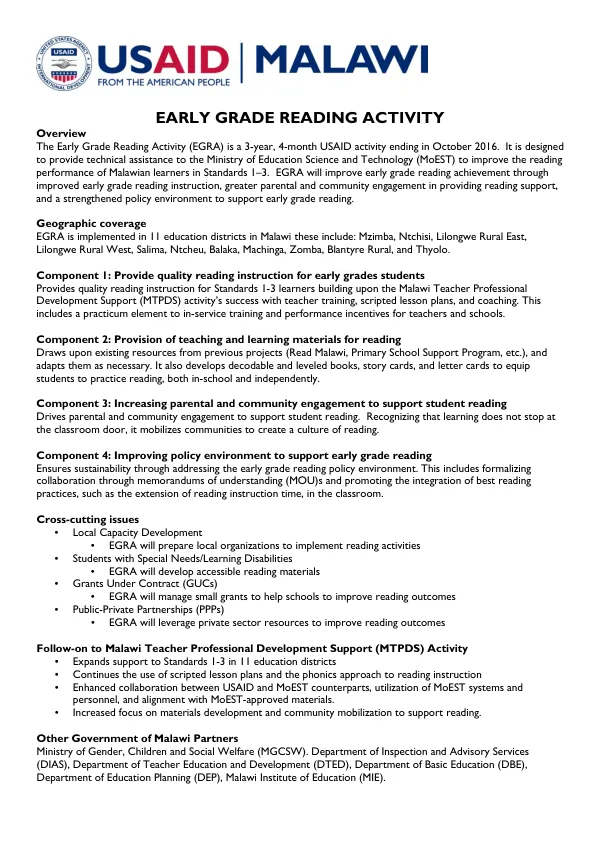
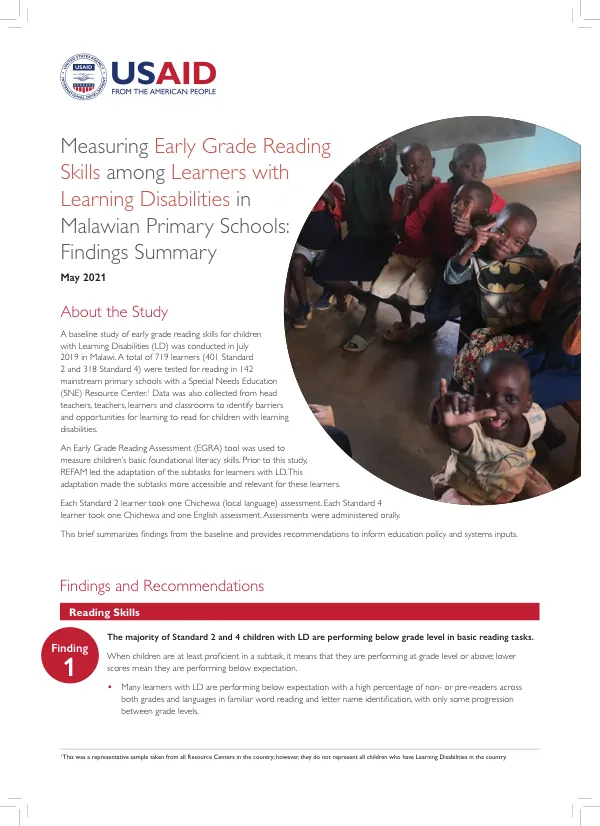
The Early Grade Reading Assessment of Standard 2 and 4 Learners with Learning Disabilities (LD) in Malawi was conducted in partnership with the Malawian Ministry of Education, Science and Technology (MoEST) and the U.S.
2019 · 62 pages
Sign in to readA free account is required to download.
Abstract
Agency for International Development (USAID). The assessment aimed to improve reading outcomes for learners with LD, those who are blind or have low vision, and learners who are deaf or hard of hearing. The study evaluated the reading skills of all children identified as having a disability in Standards 2 and 4 and attending a primary school with a Special Needs Education (SNE) Resource Center. The assessment tools were adapted from the National Reading Assessment (NRA) instruments produced by MoEST and the Yesani Ophunzira Activity (YESA) developed for mainstream schools and learners in the same grades. The field work took place in July 2019 after a pilot test and assessor training. The study involved 719 learners with LD (434 boys and 285 girls) in Standards 2 and 4 who were enrolled at 142 of the 146 primary schools with resource centers for learners with disabilities. Results from the study showed that children in the study primarily attended co-educational schools that were situated in rural areas. Most learners (85%) lived with either one or both parents, and the majority (71%) identified Chichewa as their home language. Learners from wealthier homes had greater access to support for reading skills development. A review of Individualized Education Programme (IEP) availability revealed that only 28% of children (26% of girls and 34% of boys) had an IEP to guide their educational needs. The assessment results indicated that learners with LD in Standards 2 and 4 had limited reading skills. The average scores in Chichewa for LD Standard 2 learners were significantly lower than the national average. The average scores in English for LD Standard 2 learners were also lower than the national average. The results also showed that learners with LD faced challenges in their school environment, including bullying and mistreatment. The study found that the school climate varied across schools, with some schools having a more supportive environment than others. The results also highlighted the need for improved classroom-level reading instruction and appropriate reading delivery systems to support the education of learners with LD. The study recommended that schools and policymakers prioritize the development of reading skills for learners with LD and provide them with access to resources and support services. The assessment results were used to inform policy direction in the areas of improved classroom-level reading instruction and appropriate reading delivery systems. The study provided valuable insights into the reading skills of learners with LD in Malawi and highlighted the need for targeted interventions to support their education. The results of the study can be used to inform the development of reading programs and policies that cater to the needs of learners with LD in Malawi. The study involved a range of data collection methods, including head teacher and teacher interviews, classroom observations, school climate observations, and parent questionnaires. The data were analyzed to provide insights into the reading skills of learners with LD, the resources available to support their education, and the challenges they faced in their school environment. The study's findings have implications for policymakers, educators, and parents in Malawi. The results highlight the need for targeted interventions to support the education of learners with LD and provide them with access to resources and support services. The study's recommendations can be used to inform the development of reading programs and policies that cater to the needs of learners with LD in Malawi.