INDONESIAN MINISTRY OF RESEARCH, TECHNOLOGY, AND HIGHER EDUCATION
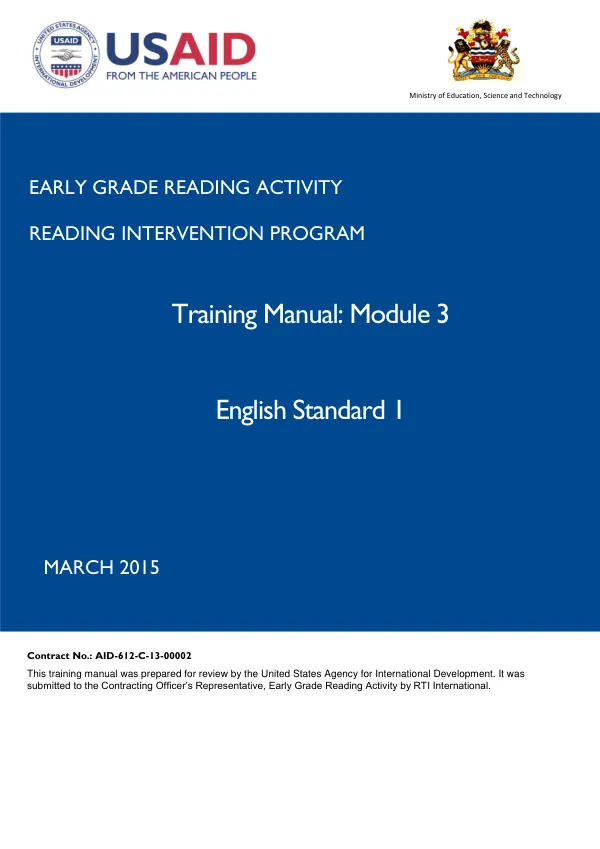
Early Grade Reading Activity English Standard 1 Module 3 Training Manual
The Early Grade Reading Activity (EGRA) is a 40-month United States Agency for International Development (USAID) intervention aimed to enhance the quality of primary education in Malawi.
2015 · 18 pages
Sign in to readA free account is required to download.
Abstract
EGRA provides technical assistance to the Ministry of Education, Science and Technology (MoEST) in implementing teacher education support and literacy materials development. Building on the achievements of previous activities, EGRA features a strong element of community mobilisation and of inclusive education for learners with special learning needs. The program targets teacher trainers, teachers, school administrators, parents, and other key community members in 11 districts, with a special focus on improving literacy skills at the lower primary level. To improve early grade reading, EGRA and MoEST are implementing an early grade literacy intervention in these 11 districts that is geared toward the development of basic literacy skills and knowledge. Focusing on schools and the wider community within which the schools operate, the program provides training to teachers, head teachers, and primary education advisors (PEAs) on how to effectively teach reading in the early grades. An additional focus is the teaching of English as a subject and in preparation for later learning of all subjects through the medium of English. For parents, caregivers, and other key community members, EGRA provides training and ongoing support so that young learners' reading can be encouraged and improved both within school and at home. The English Standard 1 teachers' guide has been developed in collaboration with the MoEST, and is based on the National Primary Curriculum (NPC) learners' book. The focus of teaching and learning in this course is the development of speaking and listening skills. It is essential for learners to build a vocabulary of familiar words and to understand and be able to respond to a range of classroom instructions in English. Phonological awareness and alphabetic principle are also addressed, preparing learners to be able to read and write in English in Standard 2 and beyond. This training module has been designed to strengthen the skills and knowledge already established through modules 1 and 2. The training module is structured to provide participants with the opportunity to reflect on their practice, share experiences about what works well, and develop strategies for dealing with challenges that have emerged in their teaching of English so far. Continuous assessment is also a focus of this course, so that teachers can consider how to assess learners' progress in English at the end of Year One. The training program includes sessions on registration, welcome, and introductions, participants' expectations, the objectives of the module, achievements and challenges experienced and observed in Term 1, practice of the more challenging lesson activities, assessing learners, a recap of the letter sounds and names, songs in Term 3, action planning for completion of the course, and review of expectations and final Q&A. The training program is designed to be implemented over a period of time, with sessions scheduled from 8:00 to 4:30. The program includes breaks and lunch, and is intended to provide participants with the opportunity to engage in discussions, share experiences, and develop strategies for improving their teaching of English. The program is focused on improving literacy skills at the lower primary level, and is designed to be implemented in 11 districts in Malawi.