USAID DEC
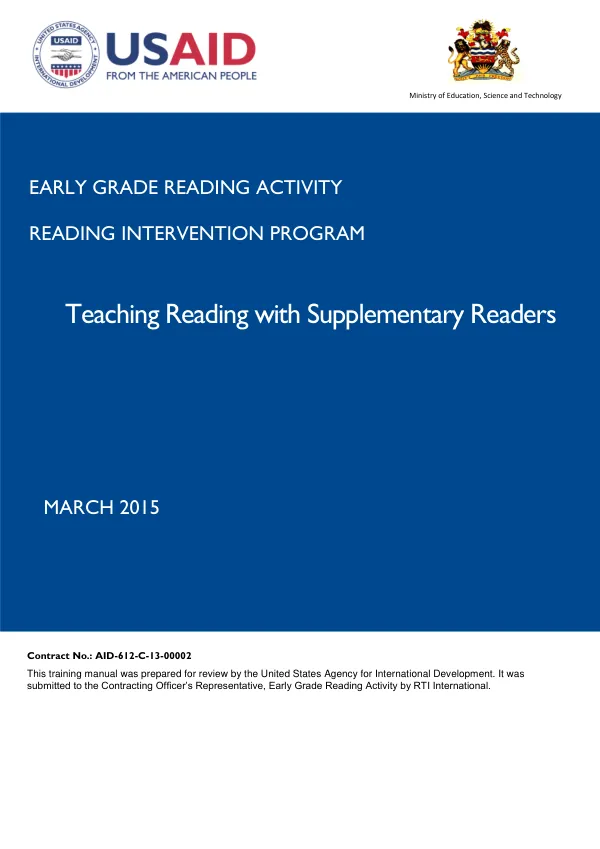
Early Grade Reading Activity: Teaching with Supplementary Readers Standards 1, 2 and 3 Module 3
Sign inINDONESIAN MINISTRY OF RESEARCH, TECHNOLOGY, AND HIGHER EDUCATION
Early Grade Reading Activity: Teaching with Supplementary Readers Standards 1, 2 and 3 Module 3
The Early Grade Reading Activity (EGRA) is a 40-month United States Agency for International Development (USAID) intervention aimed to enhance the quality of primary education in Malawi.
2015 · 19 pages
Sign in to readA free account is required to download.
Abstract
EGRA provides technical assistance to the Ministry of Education, Science and Technology (MoEST) in implementing teacher education support and literacy materials development. The program targets teacher trainers, teachers, school administrators, parents, and other key community members in 11 districts, with a special focus on improving literacy skills at the lower primary level. To improve early grade reading, EGRA and MoEST are implementing an early grade literacy intervention in Chichewa and English in these 11 districts. The program focuses on schools and the wider community within which the schools operate, providing training to teachers, head teachers, and primary education advisors (PEAs) on how to effectively teach reading in the early grades. An additional focus is the use of supplementary readers in Chichewa and English to strengthen reading skills and develop a culture and love of reading, in class, at home, and in community reading centers. The training manual for EGRA's Teaching with Supplementary Readers Standards 1, 2, and 3 Module 3 provides guidance on managing the stock of readers, using them for guided reading, and for children to take home to read with parents and in community reading centers. The manual is the product of collaboration among government officials, scholars, practitioners, and education development professionals, and is dedicated to improving early grade literacy and learning outcomes for all children in Malawi. The training program is structured to provide a comprehensive understanding of the use of supplementary readers in teaching reading. The program includes sessions on welcome, devotions, and introductions; the objectives of the training; why supplementary readers are needed; an overview of the supplementary reading materials provided in EGRA; taking care of the books; when to use the supplementary readers; and managing the use of the readers for home and community reading. The program also includes a practicum and feedback session to provide hands-on experience with the use of supplementary readers. The supplementary readers provided in EGRA are designed to strengthen reading skills and develop a culture and love of reading in Chichewa and English. The readers are intended for use in class, at home, and in community reading centers, and are designed to be used in conjunction with the National Primary Curriculum (NPC). The readers are accompanied by a teachers' guide and a learners' book, and are intended to be used by teachers, head teachers, and primary education advisors (PEAs) to provide training and support to teachers and learners. The program's focus on community mobilization and inclusive education for learners with special learning needs is a key aspect of EGRA's approach to improving early grade reading. The program recognizes the importance of community involvement in education and seeks to engage parents, teachers, and other community members in the process of improving literacy skills and learning outcomes for all children in Malawi.
Related documents