USAID DEC
Early Grade Reading Assessment (EGRA) Adaptation Guide for Learners with Disabilities
Sign inUSAID
Early Grade Reading Assessment (EGRA) Adaptation Guide for Learners with Disabilities
The Early Grade Reading Assessment (EGRA) is a tool designed to measure reading skills of learners in early grades.
2021 · 61 pages
Sign in to readA free account is required to download.
Abstract
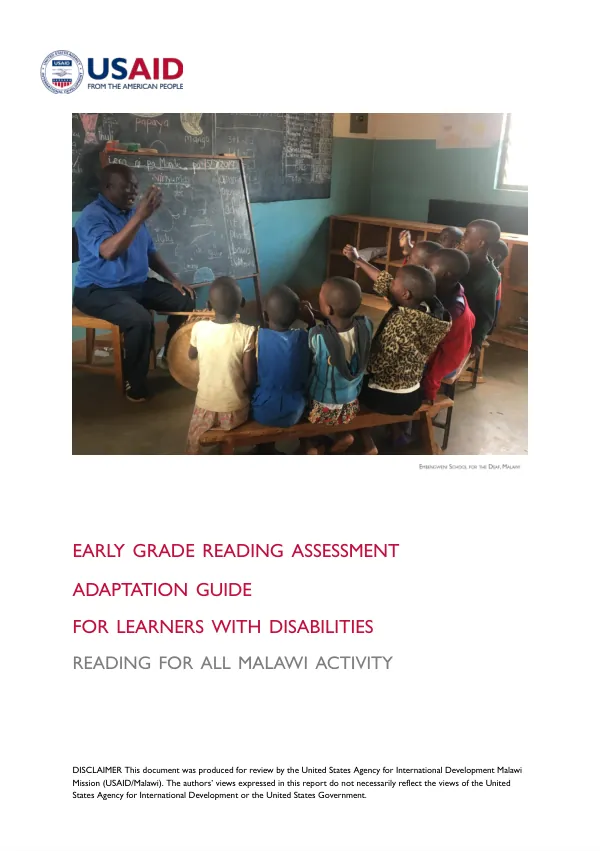
The assessment is part of the Reading for All Malawi (REFAM) Activity, which aims to improve reading skills of learners in Malawi. The REFAM Activity is a USAID-funded program that works in partnership with the Malawian Ministry of Education (MoE) to improve reading skills of learners in Malawi. The EGRA assessment is used to measure reading skills of learners in grades 1-3. The assessment consists of several subtasks that measure different aspects of reading skills, including phonemic awareness, alphabet knowledge, decoding, and comprehension. The assessment is administered to a sample of learners in each school, and the results are used to identify areas where learners need additional support. The REFAM Activity has adapted the EGRA assessment to make it more accessible to learners with disabilities. The adapted assessment includes modifications to the subtasks to make them more accessible to learners with visual, hearing, or learning disabilities. The modifications include the use of braille and large print fonts, the use of sign language, and the use of video to document correct signing and support scoring of subtasks. The REFAM Activity has also developed a guide for adapting the EGRA assessment for learners with disabilities. The guide provides step-by-step instructions for adapting the assessment, including selecting an appropriate team, logistics, and setting workshop norms. The guide also includes a checklist for assessment modification and a table of possible accommodations for learners with disabilities. The REFAM Activity has conducted a pilot test of the adapted EGRA assessment to ensure that it is effective and accessible to learners with disabilities. The pilot test was conducted in several schools in Malawi, and the results showed that the adapted assessment was effective in measuring reading skills of learners with disabilities. The REFAM Activity has also developed a learner questionnaire, teacher and head teacher questionnaires, classroom observations, and school climate and resource center observations to complement the EGRA data. The learner questionnaire is used to gather information about learners' reading habits and attitudes towards reading, while the teacher and head teacher questionnaires are used to gather information about teachers' and head teachers' perceptions of learners' reading skills. The REFAM Activity has also developed a sampling plan and intake plan to ensure that the assessment is representative of the population of learners with disabilities in Malawi. The sampling plan includes a random selection of schools and learners, while the intake plan includes a systematic approach to selecting learners for the assessment. The REFAM Activity has also trained a team of assessors and disability experts to administer the adapted EGRA assessment. The training program includes a comprehensive approach to training assessors on the adapted assessment, including the use of braille and large print fonts, the use of sign language, and the use of video to document correct signing and support scoring of subtasks. The REFAM Activity has also developed a plan to ensure inter-rater reliability, which is essential for ensuring that the assessment is consistent and reliable. The plan includes a systematic approach to training assessors on the adapted assessment and ensuring that they are familiar with the assessment tools and procedures. The REFAM Activity has also identified common mistakes that can be made when administering the EGRA assessment, including not providing adequate accommodations for learners with disabilities, not following the assessment procedures, and not ensuring that the assessment is administered in a fair and consistent manner. Overall, the REFAM Activity has made significant progress in adapting the EGRA assessment to make it more accessible to learners with disabilities in Malawi. The adapted assessment has been piloted and tested, and the results show that it is effective in measuring reading skills of learners with disabilities. The REFAM Activity has also developed a comprehensive plan to ensure that the assessment is administered in a fair and consistent manner, and that the results are used to inform education planning and implementation.