CHEMONICS
Final Workshop Report: Inclusive Education Workshop for Rwanda
The Soma Umenye initiative aims to improve reading outcomes in Kinyarwanda for at least 1 million children in public and government-aided schools in Rwanda.
2019 · 23 pages
Sign in to readA free account is required to download.
Abstract
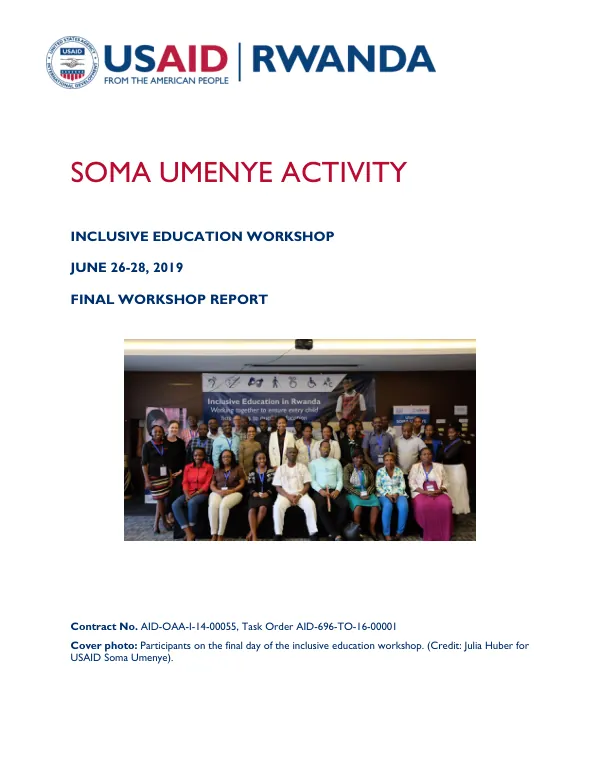
The initiative targets all children in Grades 1-3 attending public and government-aided schools nationwide and seeks to ensure that at least 70 percent of students are able to read grade-level text with fluency and comprehension. The government of Rwanda has demonstrated commitment to supporting students with special educational needs (SEN) and those with disabilities. This commitment is reflected in the Ministry of Education's (MINEDUC) Strategic Priority Number 7 of Education Sector Strategic Plan Framework for basic education (ESSP) 2018/19-2023/24, and specifically Outcome 7.2, which has a stated goal to "increase the participation and achievement of children with disabilities and SEN at all levels of education." Additionally, the 2016 competence-based curriculum (CBC) was designed to be accessible to all students, including those with learning difficulties and disabilities. The recent Cabinet approval of the Special Needs and Inclusive Education Policy (2019) demonstrates further renewal of the government of Rwanda's commitment to supporting inclusive education for all students. This policy builds upon the previous special needs education policy (2007) and incorporates new and revised policies at the national and international level, including but not limited to the Rwandan Integrated Child Rights Policy (2011), Ministerial Order N° 007/2016 of 01/03/2016 determining modalities for special treatment of persons with disabilities in schools, and the Sustainable Development Goals. A three-day workshop was convened from June 26-28, 2019, for a variety of stakeholders to identify critical next steps in the policy's implementation plan. The workshop aimed to develop structured, targeted, and harmonized interventions, grounded in the Rwandan context, to support inclusive education. The objectives of the workshop were to define realistic interventions that respond to the current context and constraints and can be successfully implemented in the short term, provide partners and stakeholders a space to share existing tools and resources, and strengthen processes for frequent knowledge sharing and collaboration within established networks and working groups. The workshop convened over 60 representatives from the government of Rwanda, teacher training colleges, national NGOs/civil society organizations, disability organizations, school representatives, implementing partners, and the private sector. Several areas of the special needs education (SNE) policy were chosen as focus areas for the workshop, including policy context and inclusive education framework, identification of students with disabilities and special education needs, strengthening teacher training and multidisciplinary support provisions to foster inclusive learning, learning assessments of students with disabilities and special education needs, leadership and coordination of inclusive education activities, and accessible digital content for students with disabilities and special education needs. The workshop included sessions on policy context and inclusive education framework, identification of students with disabilities and special education needs, strengthening teacher training and multidisciplinary support provisions to foster inclusive learning, learning assessments of students with disabilities and special education needs, leadership and coordination of inclusive education activities, and accessible digital content for students with disabilities and special education needs. The workshop also included a hands-on presentation on how to leverage accessible digital content for students with disabilities and special education needs. The Minister of Education, the Director General of REB, and the US Ambassador launched the Inclusive Education Workshop on June 26, 2019. Dr. Irénée Ndayambaje, Director General of REB, welcomed participants and thanked partners for their consistent support in addressing the challenge of ensuring all children have access to quality education, including children with disabilities and special education needs. He emphasized the continued support needed to achieve this important goal. In his opening remarks, Minister of Education Eugene Mutimura gave a call to action for development partners and the government of Rwanda to work together to implement the Special Needs and Inclusive Education policy. He recognized the workshop as an opportunity for networking and harmonizing efforts, as this is the first time so many stakeholders working to promote the rights of those with disabilities have strategically looked at the implementation plan.