USAID DEC
EdData II – Évaluation de départ des compétences fondamentales en lecture (EGRA) au niveau national au Mali en 2015
Sign inRTI INTERNATIONAL
EdData II – Évaluation de départ des compétences fondamentales en lecture (EGRA) au niveau national au Mali en 2015
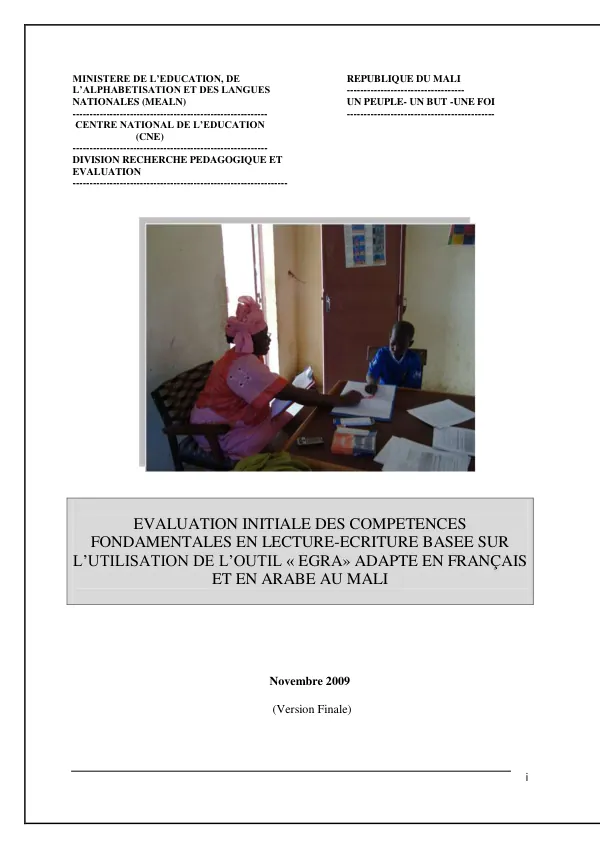
The evaluation of fundamental reading skills, Évaluation de départ des compétences fondamentales en lecture (EGRA), was conducted in Mali in 2015.
2015 · 3 pages
Sign in to readA free account is required to download.
Abstract
The first years of schooling lay the foundation for the knowledge children will acquire throughout their lives. Developing solid cognitive and linguistic bases enables children to learn to read and ensures their success in primary school, secondary school, and beyond. The EGRA assessment tool evaluates essential aspects of reading mastery, providing insights into whether students in Malian primary schools learn to read and, if not, which skills are lacking. The EGRA 2015 evaluation was conducted in three regions of Mali: Koulikoro, Sikasso, and Ségou. Over 2,800 students from 149 schools were assessed. The results showed that 66% of children in the second year could not read a single word in Bambara, and 70% could not read a single word in French, compared to 83% and 94% in the 2009 EGRA. Although the conclusions of 2009 and 2015 cannot be directly compared due to differences in the samples, the two studies generally indicate a slight reduction in zero scores, while the situation for the majority of children has not changed: they do not learn to read in either French or Bambara during the first two years of school. In the three targeted regions, only 2% of students achieved the national threshold of 31 familiar words read per minute. In Ségou, 5% of students in curriculum and classical schools achieved or exceeded this threshold; in Koulikoro, this percentage was 2%, and in Sikasso, no student achieved this threshold. However, assuming all other variables are equivalent, children who learn to read in the language they speak at home (Bambara) have fewer zero scores and better accuracy (percentage of correct responses out of total responses) than children who learn to read in French. The results of the EGRA in Bambara in curriculum schools in the three regions showed that students in the second year were able to read a short text with a rate of 4 correct words per minute. The score of students in Sikasso was lower in all reading exercises in Bambara. Students in curriculum schools acquired basic comprehension of French oral, but this comprehension was mainly related to objects present in the classroom. In classical schools, French is both the medium of instruction and the language of reading acquisition. On average, students in the second year read 3.2 words per minute, but 70% of children could not read a single word from the reading passage presented to them. The scores in French oral vocabulary were similar to those of children in curriculum schools who learned to read in Bambara and learned French as a second language, whereas one might expect students in classical schools to perform better due to greater exposure to French. There was no significant difference between the performances of boys and girls in reading exercises in both languages in both curriculum and classical schools.
Related documents