MINISTRY OF EDUCATION
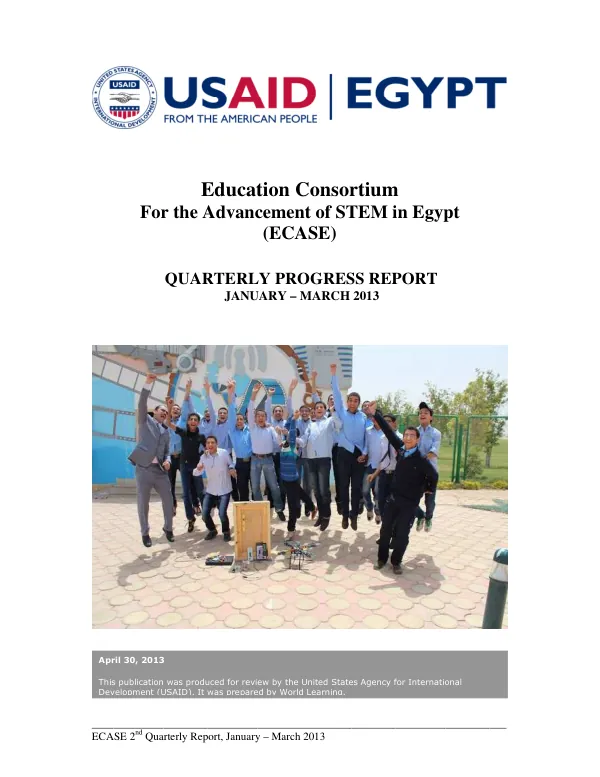
ECASE 2nd Quarterly Report, January – March 2013
The Education Consortium for the Advancement of STEM in Egypt (ECASE) Program is a USAID-funded initiative aimed at promoting science, technology, engineering, and math (STEM) education in Egypt.
2013 · 25 pages
Sign in to readA free account is required to download.
Abstract
The program's activities during the second quarter of 2013, spanning January 1 to March 31, focused on implementing the program's objectives in accordance with the implementation plan. School design was a key area of focus, with the ECASE team working with government officials, the Ministry of Education (MOE), and other stakeholders to design schools specific to the needs of the community. The team leveraged the full school design process to develop a STEM School Design Blueprint, which will serve as a roadmap for replication of STEM schools in Egypt. The blueprint will encompass the full breadth of work across the ECASE team and provide Egyptians with a framework for developing STEM schools. Curriculum development was another critical area of focus, with the 21st Century Partnership for STEM Education (21PSTEM) creating a curriculum scope and sequence for math and science. The curriculum process will enable the creation of an overall curriculum to be completed by early June 2013, with the intent to provide teacher professional development in the summer of 2013 for 6th of October, Ma'adi, and Mansoura schools. The curriculum will leverage interim curriculum books and kits ordered for the schools, with further content to be developed and/or selected to supplement the full curriculum. Professional development was also a key area of focus, with the TIES team providing training on STEM best practices for teachers and administrators. The training sessions in January/February 2013 focused on helping teachers transfer previous professional development into the classroom, emphasizing good evidence of learning. The sessions also initiated Professional Learning Communities (PLCs) to enable ongoing practice improvement among teachers. The TFI team observed practices and focused on training to enable sustainability of best practices being taught and adopted, with a critical risk identified as the lack of an instructional leader present on the ground on a daily basis. English proficiency was also a key area of focus, with STEM school curriculum using a trans-disciplinary approach to enhance students' abilities to use project-based learning to address real-world issues. The English-medium schools provide all content in English, preparing students with the knowledge and skills required to enter top-notch universities. The ECASE team also provided students with extra-curricular opportunities to visit Fab Lab Cairo in support of their capstone projects, with further integration between Fab Labs, Capstones, and the Curriculum to be enabled this summer as the Curriculum 1.0 is designed and as Fab Labs are installed and the staff is trained in August. The ECASE team also worked on several other initiatives during the second quarter, including the development of a procurement bill of quantities, the establishment of a targeted field trip program, and the creation of an observation protocol instrument. Overall, the ECASE Program made significant progress during the second quarter of 2013, with a focus on implementing the program's objectives and developing a STEM School Design Blueprint. The program's activities will continue to focus on promoting STEM education in Egypt, with a goal of developing a sustainable and replicable model for STEM education in the country.
Related documents