USAID
ECASE 8th Quarterly Report, July - September 2014
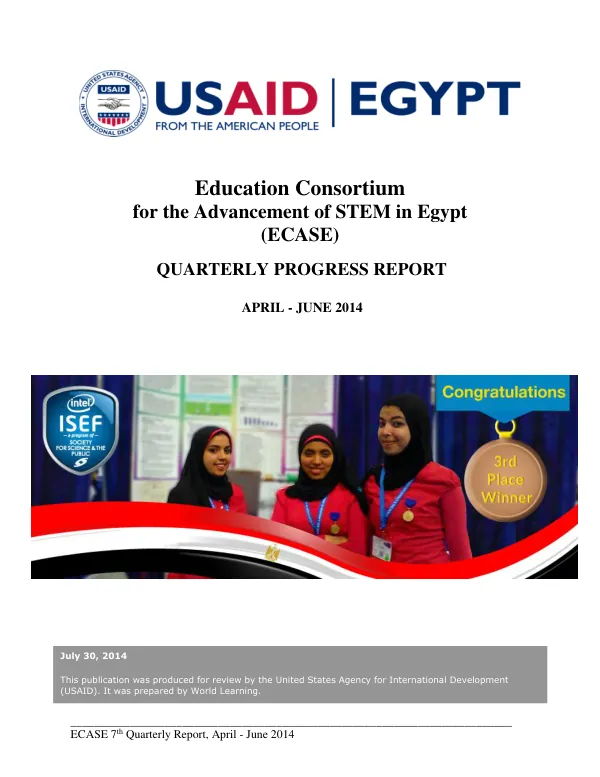
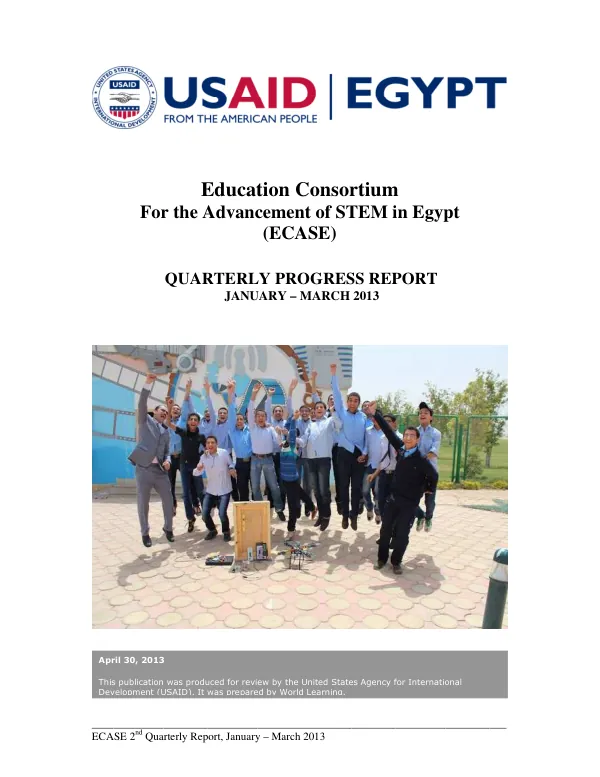
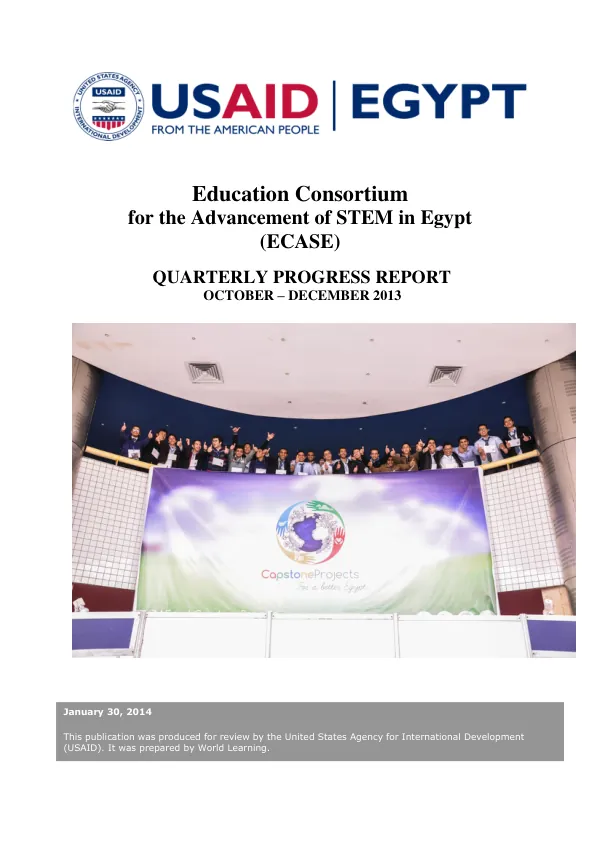
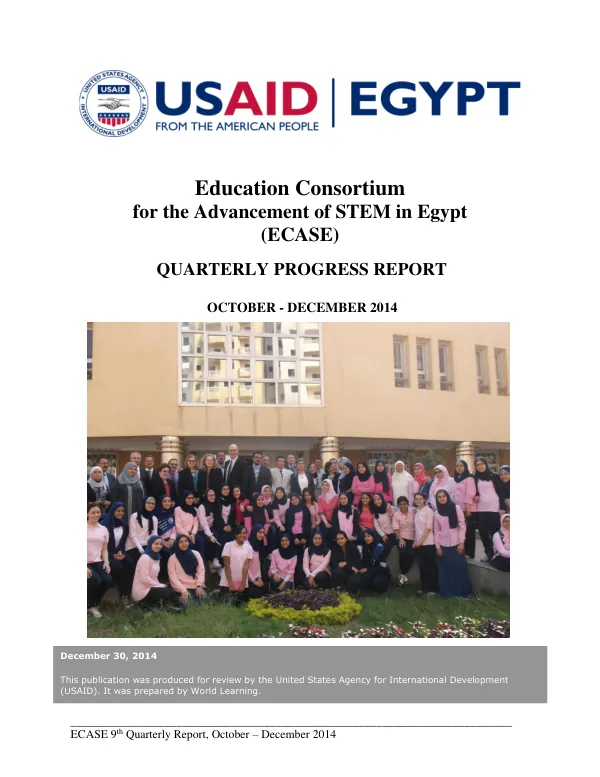
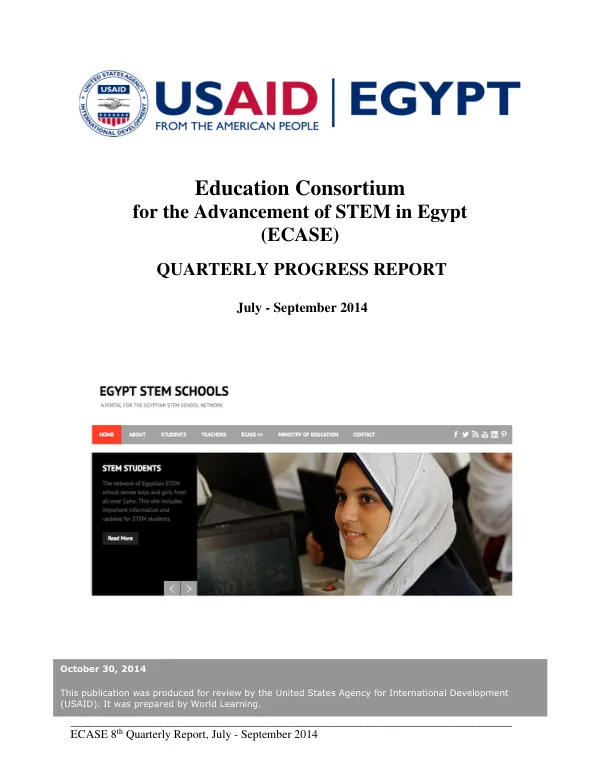
The Education Consortium for the Advancement of STEM in Egypt (ECASE) implemented a STEM education program in Egypt, with a focus on increasing student interest and achievement in science and mathematics.
2014 · 32 pages
Sign in to readA free account is required to download.
Abstract
The program was funded by the United States Agency for International Development (USAID) and managed by World Learning. ECASE achieved significant milestones throughout the first two years of the program, including the establishment of two STEM schools and the development of a STEM model that is ready to be replicated. However, the program faced challenges due to the Wind-up and Roll-back notifications received from USAID in 2013 and 2014. The Wind-up notification instructed ECASE to give sufficient time and resources to existing activities to allow for their orderly closure, while the Roll-back notification instructed ECASE to resume its project efforts as originally designed and awarded. As a result of the Wind-up and Roll-back notifications, ECASE had to reduce and retract its efforts, restart and activate dormant activities, and restart the implementation of new schools. This resulted in an unavoidable delay and made it nearly impossible to start new schools in September 2014. Other activities related to new schools, such as school specialization and mapping, outreach to preparatory schools, and PPP work, were also put on hold or significantly negatively affected by the Wind-up process. ECASE was setup to work with the STEM Board as its primary counterpart in taking decisions related to the operation of the schools. However, the Board's leadership changed during the second year of implementation, with Dr. Amr Ezzat Salama reducing his active role and the Minister of Education taking over. This shift in leadership helped the schools but also necessitated the presence and development of an unplanned intermediate executive body to receive necessary know-how from ECASE consultants and work with ECASE to sustain activities within the schools beyond ECASE. ECASE's activities and tasks that could not be implemented during the Wind-up period included implementing an admissions system, promoting the STM School within the surrounding community, promoting parent involvement, educating and mobilizing STM community advocates, and outreach to Egyptian Preparatory Schools. Other activities, although implemented, were significantly slowed due to the instability of the process. The program's objectives included increasing student interest, participation, and achievement in science and mathematics, with a special effort geared to underrepresented groups such as girls and economically marginalized students. The program also aimed to strengthen the STM School local initiative through developing an effective model of specialized high schools focusing on science, technology, and mathematics for gifted students. ECASE's partnership with the Ministry of Education (MOE) was crucial to the program's success. The MOE provided scholarships with private universities, which helped the schools but also necessitated the presence and development of an unplanned intermediate executive body to receive necessary know-how from ECASE consultants and work with ECASE to sustain activities within the schools beyond ECASE. The program's impact was evident in the establishment of two STEM schools and the development of a STEM model that is ready to be replicated. However, the Wind-up and Roll-back notifications had a significant impact on the program's implementation, resulting in delays and challenges in achieving the desired results.