MINISTRY OF EDUCATION
ECASE 7th Quarterly Report, April - June 2014
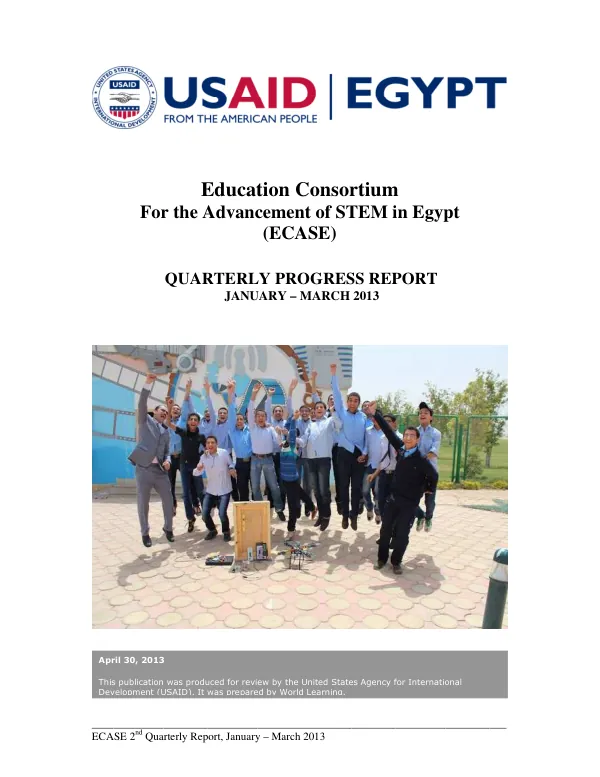
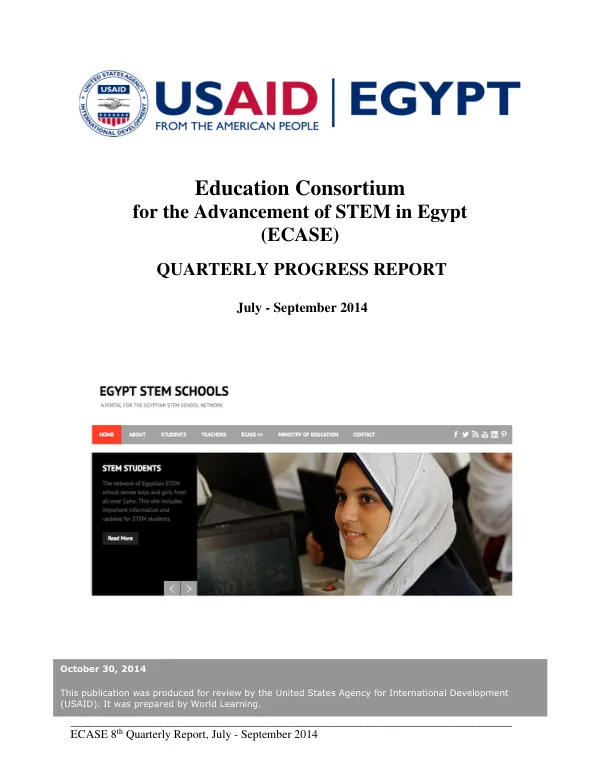
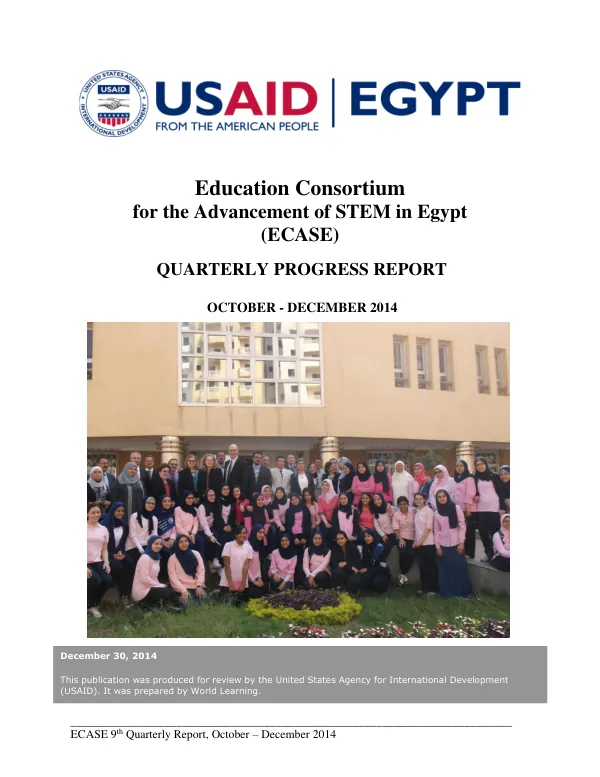
The Education Consortium for the Advancement of STEM in Egypt (ECASE) is a USAID-funded program aimed at promoting science, technology, engineering, and math (STEM) education in Egypt.
2014 · 25 pages
Sign in to readA free account is required to download.
Abstract
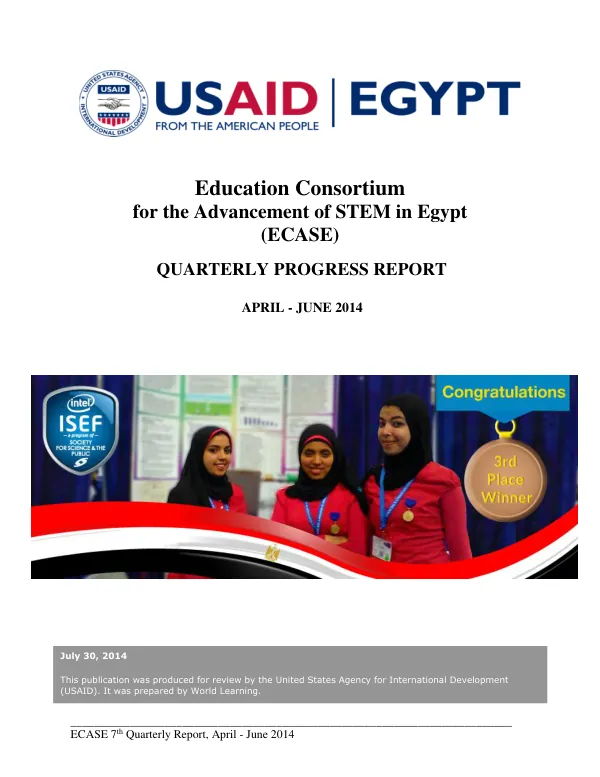
The program is implemented by World Learning and its partners, including The Franklin Institute (TFI), 21st Century Partnership for STEM Education (21PSTEM), and Teaching Institute for Excellence in STEM (TIES). During the 7th quarter of the program, which spanned from April 1 to June 30, 2014, significant progress was made in achieving the program's objectives. One notable achievement was the success of a team of students from Maa'di STEM School for Girls, who won a Grand Award at the Intel International Science & Engineering Fair in Los Angeles for their research project titled "Vacuum Evaporator for Water Purification." The team's project demonstrated the potential of vacuum evaporation in industrial wastewater treatment systems, and their achievement was recognized with a third-place medal in the prestigious competition. The USAID Mission Director, Dr. Mary C. Ott, visited the Maa'di School to witness the program's achievements and meet with the school's students and teachers. The visit was accompanied by other high-ranking officials, including Ambassador Thomas A. Shannon and Charge d'Affaires Mark Sievers. The delegation was impressed by the students' proficiency in science and technology, and the visit was widely covered in the local media. ECASE also collaborated with the Ministry of Education's (MOE) STEM Unit to implement the end-of-semester Capstones for all grades in both Cairo schools. The program is transitioning the evaluation of the Capstones to the MOE STEM Unit, and various STEM Unit members participated as evaluators or organizers for the Capstone Events. This transition is an important step towards building the capacity of the MOE STEM Unit and ensuring the sustainability of the program's impact. The program's activities have been well-received by the students, teachers, and officials involved. The students have demonstrated a high level of proficiency in science and technology, and the program's approach has been recognized as a model for STEM education in Egypt. The program's achievements have also been recognized by the international community, with the Maa'di School's students winning a prestigious award at the Intel International Science & Engineering Fair. The ECASE program has made significant progress in promoting STEM education in Egypt, and its achievements have been recognized both locally and internationally. The program's focus on building the capacity of the MOE STEM Unit and transitioning the evaluation of the Capstones to the unit is an important step towards ensuring the sustainability of the program's impact.
Related documents