USAID DEC
Nutrient composition of premixed and packaged complementary foods for sale in low- and middle-income countries: Lack of standards threatens infant growth
Sign inUNIVERSITÉ DE TUFTS
Nutrient composition of premixed and packaged complementary foods for sale in low- and middle-income countries: Lack of standards threatens infant growth
The nutritional adequacy of premixed, packaged complementary foods for infants in low- and middle-income countries has been a subject of concern due to the lack of standards and quality assurance.
2017 · 10 pages
Sign in to readA free account is required to download.
Abstract
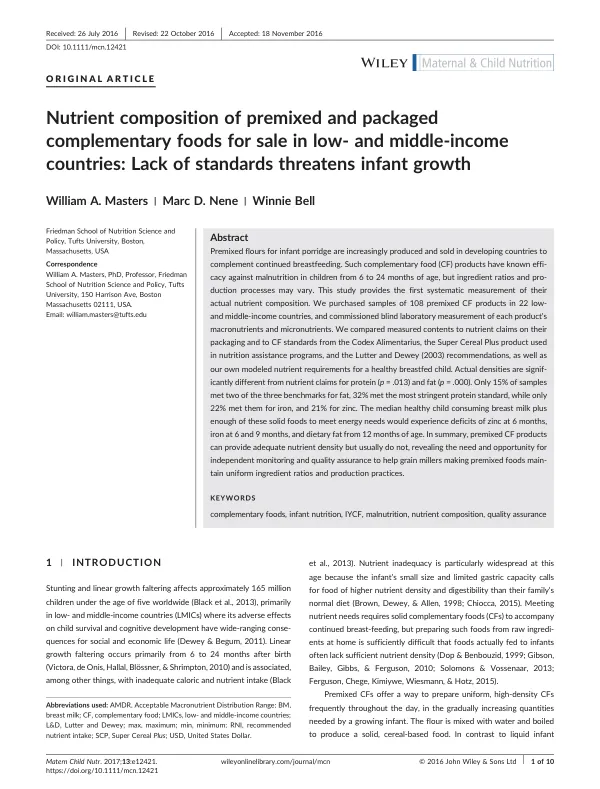
These foods are designed to complement continued breastfeeding and provide infants with the necessary nutrients for growth and development. However, the ingredient ratios and production processes used in their manufacture can vary significantly, leading to inconsistent nutrient content. A study conducted by researchers from the Friedman School of Nutrition Science and Policy at Tufts University aimed to systematically measure the actual nutrient composition of premixed complementary foods sold in 22 low- and middle-income countries. The researchers purchased 108 samples of these foods from local markets and commissioned blind laboratory measurements of their macronutrients and micronutrients. The results showed that the actual nutrient content of these foods was significantly different from the nutrient claims on their packaging for protein and fat. Only 15% of the samples met two of the three benchmarks for fat, while 32% met the most stringent protein standard. Furthermore, only 22% of the samples met the standards for iron, and 21% met the standards for zinc. The median healthy child consuming breast milk plus enough of these solid foods to meet energy needs would experience deficits of zinc at 6 months, iron at 6 and 9 months, and dietary fat from 12 months of age. The study highlights the need for independent monitoring and quality assurance to ensure that premixed complementary foods meet uniform ingredient ratios and production practices. This is particularly important in low- and middle-income countries where the nutritional needs of infants are often not met due to inadequate access to nutrient-dense foods. The study suggests that independent quality assurance services could inspect mills and test samples, offering a trademarked certification symbol assuring potential buyers that various products meet a common standard. The researchers used a global catalogue of eligible complementary foods to identify products for the study and purchased a purposeful sample of one package for each product from local markets. The samples were then sent to a commercial laboratory for measurement of total macronutrients and micronutrients. The study's findings have significant implications for the development of policies and programs aimed at improving the nutritional status of infants in low- and middle-income countries. The study's results also highlight the importance of considering the nutrient needs of infants at different ages. The researchers found that the median healthy child consuming breast milk plus enough of these solid foods to meet energy needs would experience deficits of zinc at 6 months, iron at 6 and 9 months, and dietary fat from 12 months of age. This suggests that complementary foods should be designed to meet the specific nutrient needs of infants at different stages of development. In conclusion, the study's findings emphasize the need for improved quality assurance and monitoring of premixed complementary foods sold in low- and middle-income countries. By ensuring that these foods meet uniform ingredient ratios and production practices, it is possible to provide infants with the necessary nutrients for growth and development, thereby improving their nutritional status and reducing the risk of malnutrition.
Related documents