USAID DEC
The liver transcriptome of suckermouth armoured catfish (Pterygoplichthys anisitsi, Loricariidae): Identification of expansions in defensome gene families
Sign inJOHNS HOPKINS UNIVERSITY
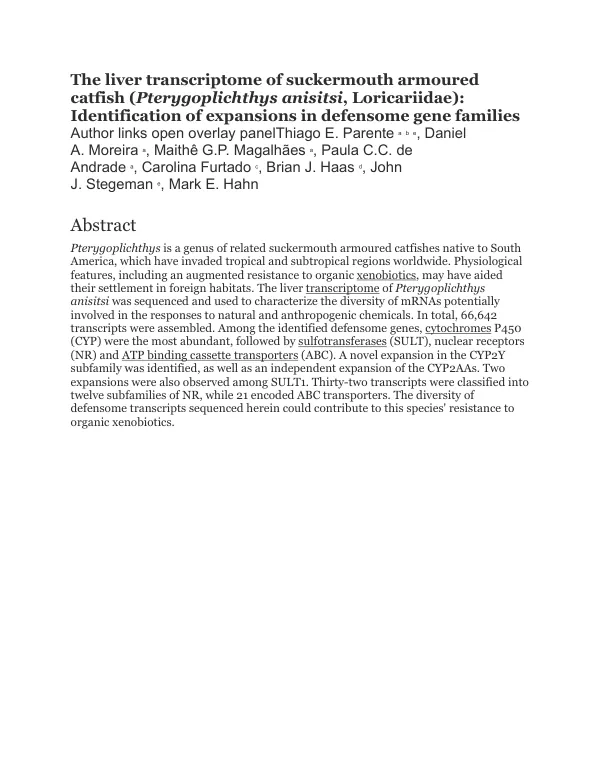
The liver transcriptome of suckermouth armoured catfish (Pterygoplichthys anisitsi, Loricariidae): Identification of expansions in defensome gene families
Pterygoplichthys is a genus of suckermouth armored catfishes native to South America, which have invaded tropical and subtropical regions worldwide.
2023 · 1 pages
Sign in to readA free account is required to download.
Abstract
Physiological adaptations, including an augmented resistance to organic xenobiotics, may have aided their settlement in foreign habitats. The liver transcriptome of Pterygoplichthys anisitsi was sequenced to characterize the diversity of mRNAs potentially involved in responses to chemicals. A total of 66,402 transcripts were assembled, with defensome genes being a significant component. Among these, cytochrome P450 (CYP) enzymes were the most abundant, followed by sulfotransferases (SULT), nuclear receptors (NR), and ABC transporters. A novel expansion in the CYP2Y subfamily was identified, as well as an independent expansion of CYP2AAs. Two expansions were also observed among SULT1. The diversity of defensome transcripts sequenced herein may contribute to this species' resistance to organic xenobiotics. The CYP2Y subfamily expansion is notable, as it suggests a significant increase in the number of genes involved in xenobiotic metabolism. This could be a key adaptation for the species to cope with the presence of pollutants in their environment. The SULT1 expansions also indicate a potential increase in the ability to detoxify organic compounds. The diversity of NR and ABC transporters may also play a role in the species' resistance to chemicals. The identified expansions in defensome gene families may be linked to the species' ability to thrive in a wide range of environments. The diversity of transcripts sequenced in this study provides insights into the molecular mechanisms underlying this adaptation. Further research is needed to fully understand the functional significance of these expansions and their role in the species' ecological success. The findings of this study contribute to the understanding of the physiological adaptations that enable Pterygoplichthys anisitsi to inhabit a wide range of environments. The identified expansions in defensome gene families highlight the importance of xenobiotic metabolism and detoxification in the species' ecological success. The diversity of NR and ABC transporters also suggests a complex molecular mechanism for coping with environmental pollutants.
Related documents