USAID DEC
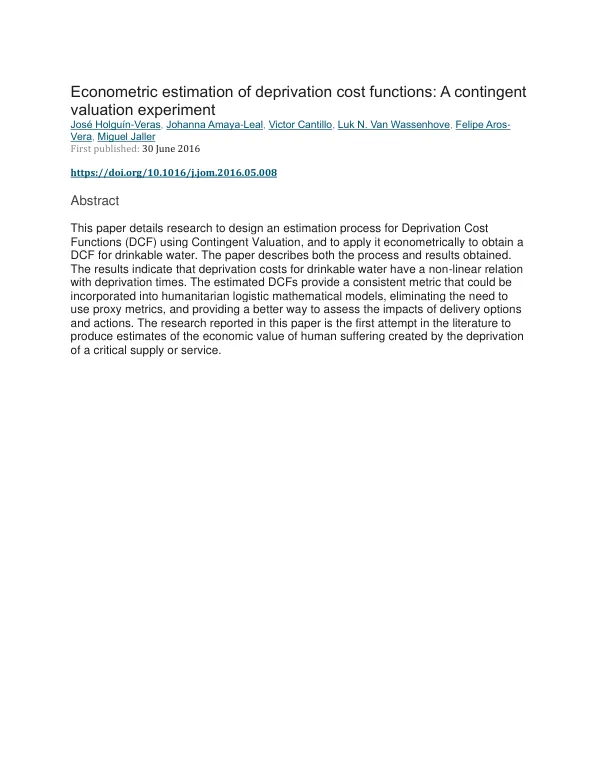
Econometric estimation of deprivation cost functions: A contingent valuation experiment
Sign inMICROSOFT CORPORATION
Econometric estimation of deprivation cost functions: A contingent valuation experiment
Deprivation Cost Functions (DCF) estimation using Contingent Valuation is a research area that aims to quantify the economic value of human suffering caused by deprivation of essential supplies or services.
2016 · 1 pages
Sign in to readA free account is required to download.
Abstract
This study focuses on designing an estimation process for DCFs and applying it to obtain a DCF for drinkable water. The research involves a contingent valuation experiment, which is a method used to elicit people's willingness to pay for a particular good or service. In this case, the experiment aimed to determine the economic value of drinkable water deprivation. The study's findings indicate that deprivation costs for drinkable water have a non-linear relationship with deprivation times. This means that the economic value of deprivation increases as the duration of deprivation increases, but at a decreasing rate. The estimated Deprivation Cost Functions provide a consistent metric that can be incorporated into humanitarian logistics mathematical models. This eliminates the need to use proxy metrics, which can be inaccurate or unreliable. The estimated DCFs also provide a better way to assess the impacts of delivery options and actions on human suffering. The research reported in this study is the first attempt in the literature to produce estimates of the economic value of human suffering created by the deprivation of a critical supply or service. The study's results have significant implications for humanitarian logistics and disaster relief efforts. By quantifying the economic value of human suffering, decision-makers can make more informed decisions about resource allocation and delivery options. The estimated DCFs can be used to evaluate the effectiveness of different delivery strategies and to identify areas where improvements can be made. This can ultimately lead to better outcomes for individuals affected by disasters or humanitarian crises. The research was conducted by a team of experts in the field of humanitarian logistics and economics. The study's findings are based on a contingent valuation experiment, which was designed to elicit people's willingness to pay for drinkable water. The results of the experiment were used to estimate the Deprivation Cost Functions, which provide a consistent metric for quantifying the economic value of human suffering. The study's results have significant implications for humanitarian logistics and disaster relief efforts, and can be used to improve decision-making and resource allocation in these areas.
Related documents
Documents in this collection
 2018
2018USAID DEC
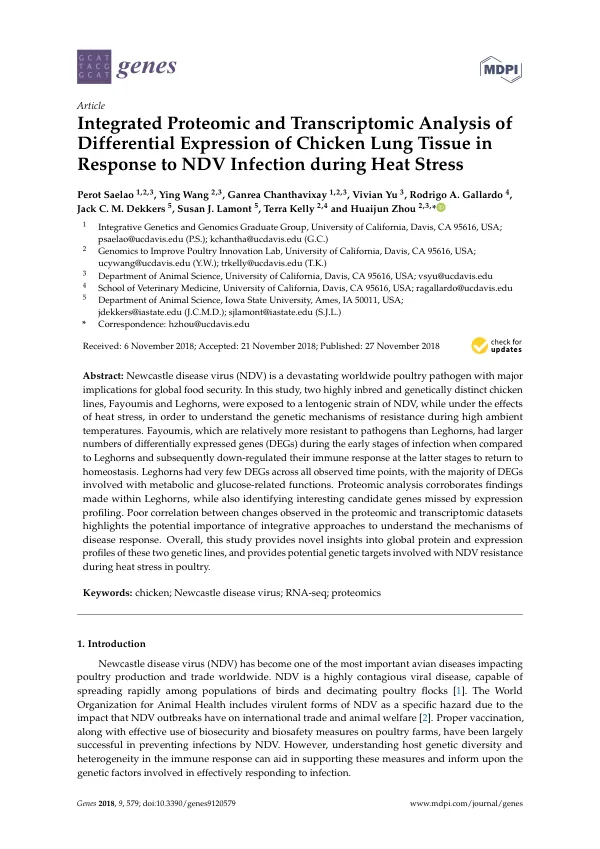
Integrated Proteomic and Transcriptomic Analysis of Differential Expression of Chicken Lung Tissue in Response to NDV Infection during Heat Stress
Open record 2016
2016USAID DEC