CORNELL UNIVERSITY. DIV. OF NUTRITIONAL SCIENCES. CORNELL FOOD AND NUTRITION POLICY PROGRAM
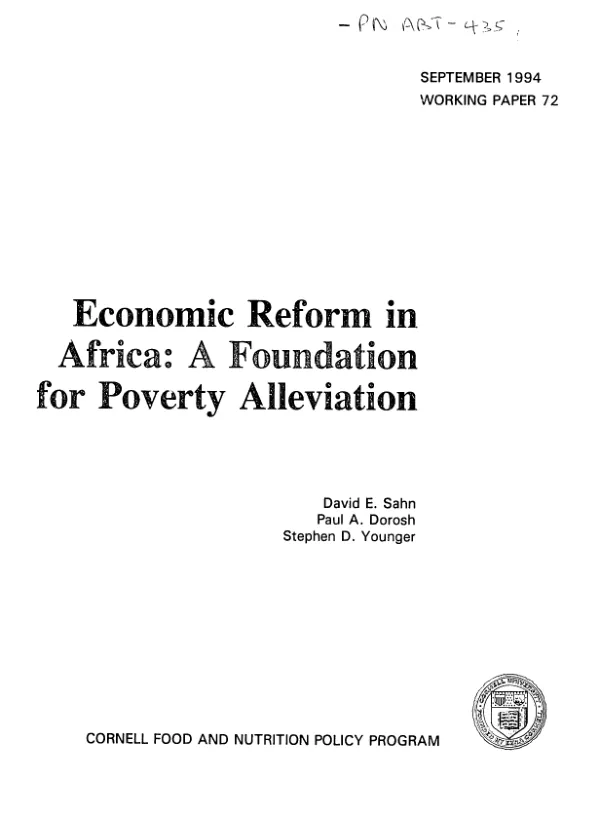
Economic reform and the poor in Africa
This compilation of analytical and empirical essays examines the effects of economic reform efforts in Africa, refuting the common argument that these reforms are inherently and disproportionately harmful to the poor.
Sahn, David E., ed. · 1970
Sign in to readA free account is required to download.
Abstract
The contributors to this volume employ empirical methods to separate the effects of the economic crises that induced countries to initiate reforms from the impact of the economic reforms themselves. Following an introduction, Part II presents case studies of trade and exchange rate reforms in Cameroon, Madagascar, Niger, and Tanzania (a case study of The Gambia is added in Part III). All five studies employ computable general equilibrium models (CGEs), built around social accounting matrices (SAM"s). Part III discusses fiscal policy reforms and their effects on Africa"s poor. Individual chapters: examine the impact of retrenchment programs in Ghana and Guinea designed to reduce public sector employment; examine the incidence of taxation prior and subsequent to the economic recovery program in Ghana; use a semi-input-output model to examine investment alternatives in Madagascar; and document the high costs for growth and poverty alleviation of failing to sustain economic reforms in Zaire. Part IV explores the performance and impact on the poor of agriculture and food markets in reform economies in Malawi, Mozambique, Guinea, The Gambia, and Ghana. Overall, the authors find that, contrary to popular belief, removing market distortions and altering relative prices in accordance with reform philosophies generally improve income distribution and raise the incomes of the poor, albeit marginally, even in the absence of large supply responses. This is not to say that no one is hurt by adjustment; those most likely to be hurt, however, are public sector workers and traders who had enjoyed access to rationed public exchange. Includes abundant references.
Related documents