CORNELL UNIVERSITY. DIV. OF NUTRITIONAL SCIENCES. CORNELL FOOD AND NUTRITION POLICY PROGRAM
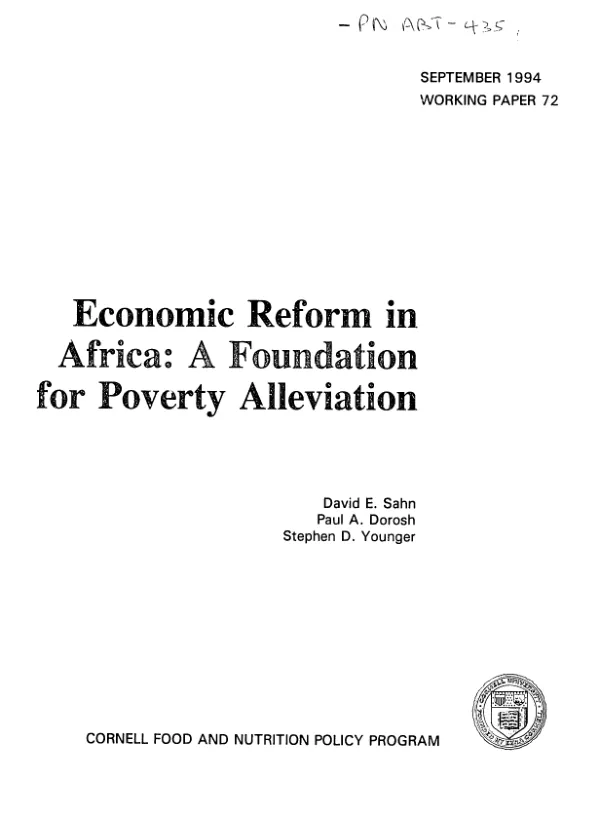
Economic reform in Africa : a foundation for poverty alleviation
Although most African countries have adopted structural adjustment programs during the past decade, the region"s economic performance and its record on poverty alleviation have been disappointing.
Sahn, David; Dorosh, Paul A. +1 more · 1994
Sign in to readA free account is required to download.
Abstract
This report discusses how Africa"s adjustment programs have affected economic performance, income distribution, and poverty, and suggests ways in which economic reform programs might be redesigned. Following an introduction, Section Two examines the salient features of poverty in Africa, using, primarily, household data; focus is on how the poor earn income, gain access to food, and allocate their expenditures. Section Three examines the effect of trade and exchange rate reforms on economic performance and household income distribution. Section Four examines the effect of reforms on the state"s role in revenue collection and in providing economic and social services, and employment. The many approaches to and results of agricultural market reforms are discussed in Section Five. Section Six draws five major conclusions. (1) Rapid and sustained growth is essential to alleviate poverty; redistribution of existing wealth and income would, in itself, be inadequate to significantly raise real incomes of the poor in most countries. (2) Structural adjustment is needed to achieve economic growth. In the short-and medium-term, adjustment policies usually help to improve income distribution and raise incomes for the poor due to factors such as lowered rents, increased economic efficiency, and improved labor productivity. (3) Generally, implementation of adjustment policies has been weak, primarily because of factors stemming from political and social conditions. (4) Carte blanche balance of payments support without rapid and sustained policy change is counterproductive, and only serves to appreciate the exchange rate, and to support governments that have proven unwilling or unable to reduce poverty. (5) Complementary investments in human resources and physical infrastructure are imperative; these can either be incorporated into adjustment loans or in many instances, and more ideally, into project lending. Includes 14-page bibliography.
Related documents