CORNELL UNIVERSITY. DIV. OF NUTRITIONAL SCIENCES. CORNELL FOOD AND NUTRITION POLICY PROGRAM
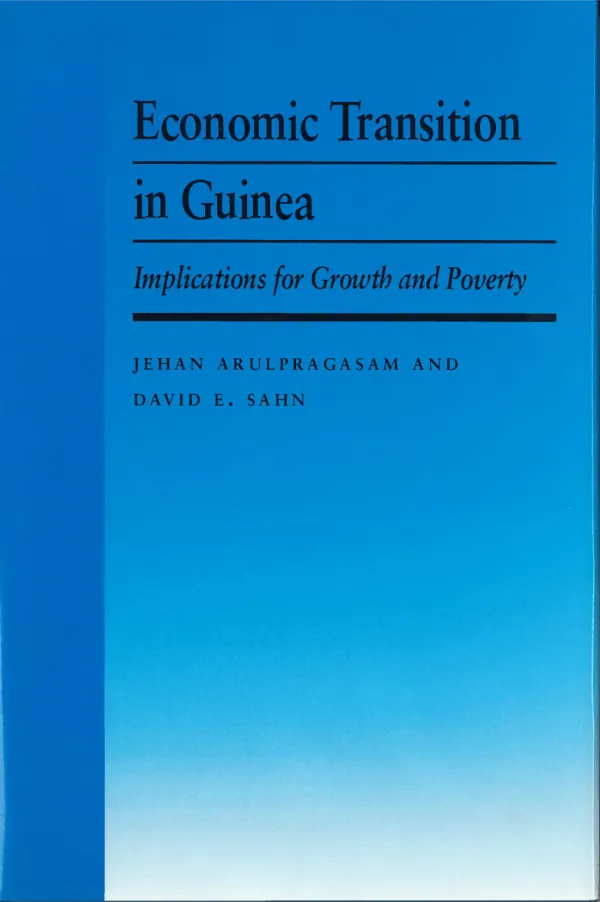
Economic transition in Guinea : implications for growth and poverty
Bold economic policy reforms have altered Guinea"s economic structure and carry important implications for the country"s social welfare.
Arulpragasam, Jehan; Sahn, David E. · 1970
Sign in to readA free account is required to download.
Abstract
This book presents the story of Guinea"s economic reform, identifying the country"s major difficulties in undertaking structural adjustment, and highlighting lessons that may apply to other African nations. Chapter 2 provides background information on Guinea"s resources, past economic performance, and recent structural adjustment program. Chapter 3 examines the effects of trade and exchange rate liberalization on the real effective exchange rate, exports, imports, and the balance of payments. Chapter 4 reviews food and agricultural policy reforms and their effects on prices, production, and markets and also on food consumption, consumer welfare, and urban poverty. Chapter 5 focuses on urban labor markets, showing how economic reforms affect the urban poor; it examines the effects of public sector retrenchment, and also the role of the non-wage sector and of small-scale enterprises in providing employment and income in a liberalized economy. Chapter 6 highlights the mining sector"s critical role as a source of foreign exchange, both before and after economic reform. Chapter 7 analyzes financial and banking sector policy changes, while Chapter 8 analyzes public sector and fiscal reforms. Each chapter opens with historical perspectives, then addresses policy reforms undertaken, and where possible, weighs the commitment to specific reforms against the actual implementation record -- although Guinea"s reform program has been sweeping and dramatic, its implementation has been fraught with institutional, administrative, and infrastructural constraints inherited from the country"s past. Finally, each chapter examines the general economic consequences of reforms on a sectoral basis, and discusses, where possible, welfare effects on households. Although many of Guinea"s reforms have not provided immediate solutions, they are far from insignificant. In some instances, reforms are already leading to desired gains. Guinea"s success points to the need for the country, as for much of Africa, to remove economic distortions. Includes references. (Author abstract, modified)
Related documents