USAID DEC
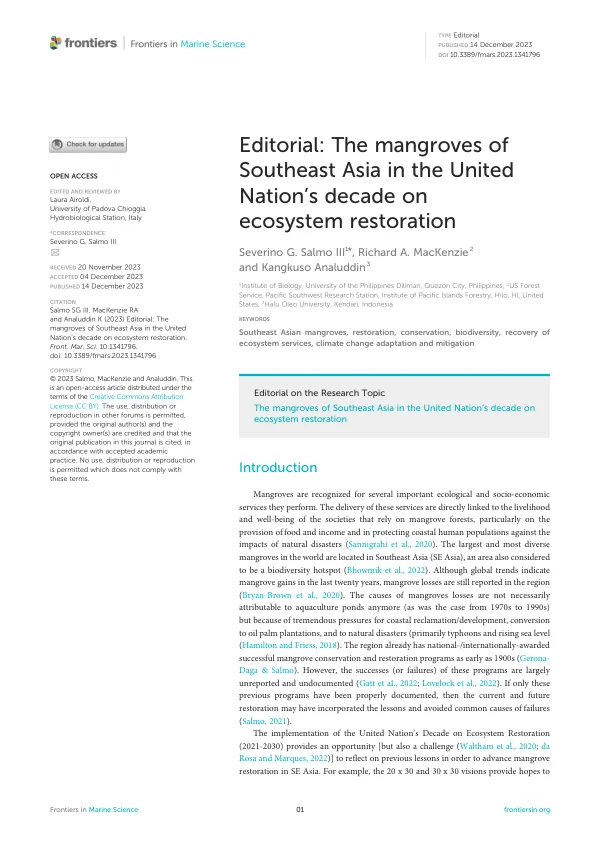
Editorial: The mangroves of Southeast Asia in the United Nation’s decade on ecosystem restoration
Sign inU.S. FOREST SERVICE
Editorial: The mangroves of Southeast Asia in the United Nation’s decade on ecosystem restoration
Mangroves in Southeast Asia are recognized for their critical ecological and socio-economic services, including the provision of food and income, and protection against natural disasters.
2023 · 4 pages
Sign in to readA free account is required to download.
Abstract
The region is home to the largest and most diverse mangrove forests in the world, which are also considered a biodiversity hotspot. Despite global trends indicating mangrove gains in the last twenty years, mangrove losses are still reported in the region, primarily due to coastal reclamation and development, conversion to oil palm plantations, and natural disasters. The causes of mangrove losses have shifted over time, with aquaculture ponds no longer being a primary driver. Instead, tremendous pressures from coastal reclamation and development, conversion to oil palm plantations, and natural disasters, such as typhoons and rising sea levels, are now the main contributors to mangrove loss. The region has had successful mangrove conservation and restoration programs in the past, but these successes are largely unreported and undocumented. The United Nations' Decade on Ecosystem Restoration (2021-2030) provides an opportunity to reflect on previous lessons and advance mangrove restoration in Southeast Asia. The 20 x 30 and 30 x 30 visions aim to deliver conservation and restoration targets by 2030. In this context, seven articles present the status and lessons, and provide perspectives for a "better" mangrove restoration strategy to help achieve the UN's targets on ecosystem restoration. One of the key challenges in mangrove restoration is the lack of restorable areas, which leads to massive mangrove planting projects being conducted in sub-optimal areas. To address this issue, an integrative restoration approach, such as the "ecological bank," has been proposed to attract more social investments and develop streamlined policies for mangrove restoration plans. This approach involves using income generated from industries using or located near mangroves to support restoration projects and provide subsidies to pond owners and social investors. Another challenge in mangrove restoration is the limited dissemination of valuation studies, which hinders their integration into policies and governance. A systematic review of ecosystem services in conserved and restored mangroves has revealed the limited studies in the region, and the authors recommend that future valuation studies should engage policymakers and incorporate a clear dissemination strategy. The eDNA technique has recently gained prominence in biodiversity assessment for most aquatic ecosystems, but its application in mangrove restoration is still limited. A review of the technical and practical limitations of eDNA metabarcoding as a biomonitoring tool in mangrove restoration programs has provided essential and practical guides for scientists, policymakers, conservation practitioners, and mangrove forest managers. Most mangrove restoration studies in the region have been conducted in response to problems associated with conversion to aquaculture, coastal erosion, and natural disasters. A systematic assessment of the impacts of restoration programs is rarely reported, and the most commonly reported impacts are ecosystem functions directly related to the recovery of ecosystem services, primarily "awareness" and "livelihood." Research topics suggested in this study provide a path forward to improve mangrove restoration and aid in the development of national and international restoration and conservation strategies. The seven articles in this Research Topic provide an overview of different mangrove restoration approaches and programs in Southeast Asia. Most restoration programs were implemented to increase mangrove cover and supplement current conservation/protection programs. However, considering that mangrove losses are still apparent and with threats from coastal reclamations and natural disasters, mangrove restoration should no longer be considered as "supplement" but rather as a necessity that needs to be expedited.