TROPICAL RESEARCH AND DEVELOPMENT, INC.
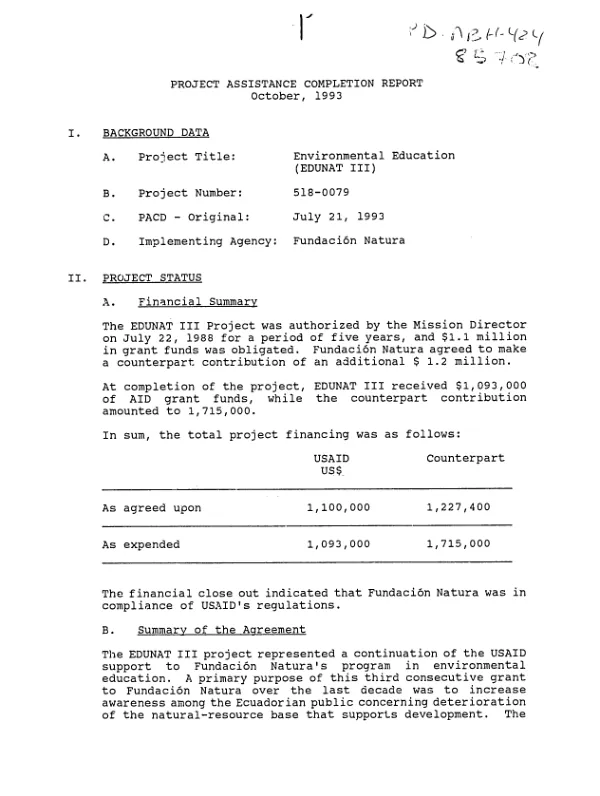
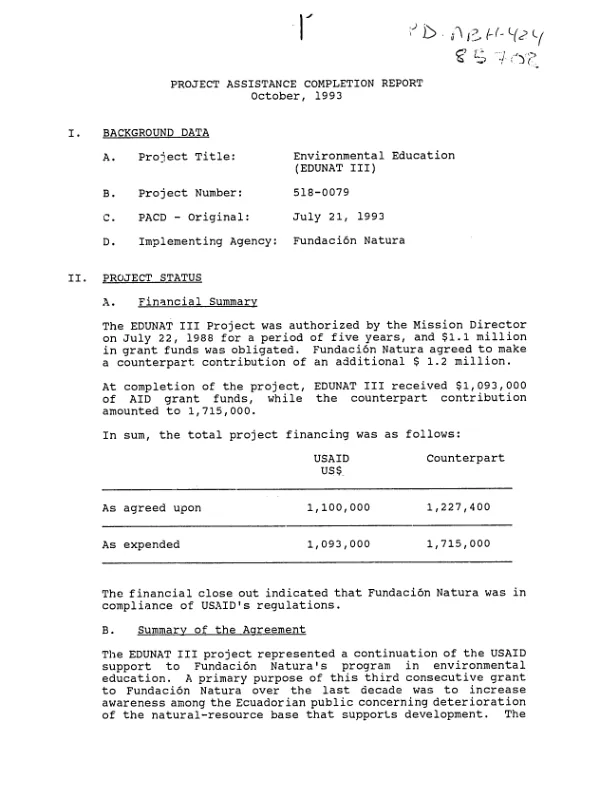
Education for Nature (EDUNAT III) : mid-term evaluation
Evaluates grant to Fundacion Natura to increase environmental awareness and promote resource management and conservation activities in Ecuador.
1992
Sign in to readA free account is required to download.
Abstract
Midterm evaluation covers the period 7/88-3/91. The project has been mostly successful and has helped make Fundacion Natura one of the most effective and widely recognized NGO's in the hemisphere. Some planned activities, however, remain unfulfilled due to time, funding, and personnel constraints. The environmental awareness component has prepared databases, surveyed the public's knowledge of environmental issues, developed radio and TV public service announcements, produced radio programs, published booklets, and pamphlets, and conducted 18 seminars for people in leadership positions. The latter have contributed substantially to national dialogue on environmental protection and management. A concrete manifestation of achievements under this component has been Ecuador's progress toward passage of a national environmental law. A major accomplishment of the industrial pollution component has been the publication of Potencial Impacto Ambiental de las Industrias en el Ecuador, the first compendium of its kind in Ecuador. This publication has heightened awareness of industrial pollution problems. The time and effort needed to collect data on the entire industrial sector were underestimated, however, with data collection complete so far on only 14% of 164 industrial processes. Also, contacts with industry have been spotty; only after publication of Potencial did many industries become aware of project activities. The project has the opportunity to overcome some of these problems as it prepares and distributes detailed reports on individual industries (vademecos). The project's greatest accomplishment has been under the environmental education component and consists of the signing of the Convenio, an interministerial agreement to institutionalize environmental education at the preschool, primary, and secondary school level. The Ministries of Health, Social Welfare and Education have contributed extensive staff and other resources to establish a decentralized administrative structure in 21 offices throughout the country, while the project has contributed educational materials and staff to conduct seminars and promote other educational activities, such as ecological clubs and local research. To date, schools have received more than 300,000 units of material, and more than 200 seminars have been held for over 8,000 teachers (the number of seminars was doubled at the request of the Ministry of Education). Several efforts have been undertaken in the community development component, including a major information and outreach campaign in Quito, credited with improving citizens' handling of garbage and in improving litter control on the streets. Additionally, training for the Ecuadoran Association of Municipalities (AME) has sensitized AME staff to environmental concerns, which are now dealt with extensively in AME's own training. Finally, the project has successfully established the Fundacion Natura document center, which houses over 15,000 documents and 700 periodicals, and is used by over 300 people every month. Lesson learned include: (1) the need for performance benchmarks (lacking in this project); and (2) the need for NGO's to consider offering competitive employment packages as a means of attracting and holding experienced professionals.