USAID. MISSION TO PAKISTAN. OFC. OF THE AID REPRESENTATIVE FOR AFGHANISTAN AFFAIRS
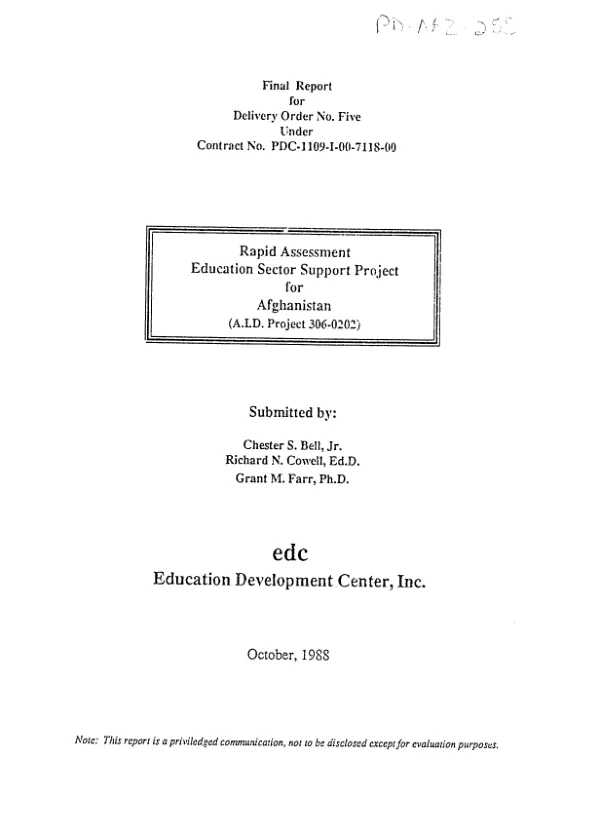
Education sector support project
Summarizes interim evaluation (PD-AAZ-255) of a project to strengthen the capacity of Afghan resistance groups in Pakistan to administer educational programs, support primary schools inside Afghanistan, and provide literacy training for Afghan Mujahideen in Pakistan.
1989
Sign in to readA free account is required to download.
Abstract
The project is implemented by the University of Nebraska at Omaha (UNO). The evaluation covered the period 1986-10/88. The Afghan resistance organization overseeing and managing the project, the Education Council of the Seven Party Alliance (ECSPA), and its operating arm, the Education Center for Afghanistan (ECA), have developed considerably with the help of UNO. Despite the difficulties of wartime conditions, the cross-border school support effort has been successful in the numbers of schools reached inside Afghanistan. However, since U.S. policy bans A.I.D. personnel from entering Afghanistan, monitoring of project impact has been difficult. This ban should be lifted in light of changing military conditions. Meanwhile, the recent appointment of ECA-trained Afghan school district directors should help measure teaching quality and bring about improvements. Substantial numbers of Mujahideen have received literacy training while in winter camps in Pakistan. Tests indicate that more than 70% achieved literacy, although doubts exist about the adequacy of literacy measurement methods. A non-degree university scholarship program was added to the project in 1987 in which Afghans nominated by their parties are trained at UNO for one year in public administration. The program is of questionable merit in terms of trainee selection, cost-effectiveness, and the need for the training offered. Nonetheless, the scholarships have served an important political purpose. Two major lessons learned are that: (1) data management and accountability questions are complex when conducting cross-border activities in countries where U.S. citizen are forbidden entryy, and (2) cooperation with other organizations carrying out similar cross-border activities can provide information by which to judge the effectiveness of A.I.D."s own activities. The project has been extended to 12/92 with additional funding.
Related documents