ACADEMY FOR EDUCATIONAL DEVELOPMENT, INC. (AED)
Educator"s guide to communication satellite technology
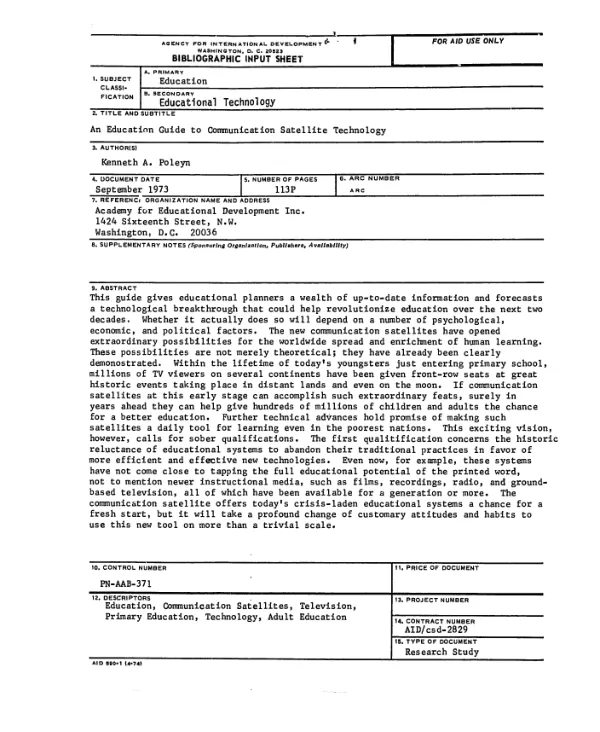
This guide gives educational planners a wealth of up-to-date information and forecasts a technological breakthrough that could help revolutionize education over the next two decades.
Polcyn, K. A. · 1970
Sign in to readA free account is required to download.
Abstract
Whether it actually does so will depend on a number of psychological, economic, and political factors. The new communication satellites have opened extraordinary possibilities for the worldwide spread and enrichment of human learning. These possibilities are not merely theoretical; they have already been clearly demonstrated. Within the lifetime of today"s youngsters just entering primary school, millions of TV viewers on several continents have been given front-row seats at great historic events taking place in distant lands and even on the moon. If communication satellites at this early stage can accomplish such extraordinary feats, surely in years ahead they can help give hundreds of millions of children and adults the chance for a better education. Further technical advances hold promise of making such satellites a daily tool for learning even in the poorest nations. This exciting vision, however, calls for sober qualifications. The first qualification concerns the historic reluctance of educational systems to abandon their traditional practices in favor of more efficient and effective new technologies. Even now, for example, these systems have not come close to tapping the full educational potential of the printed word, not to mention newer instructional media, such as films, recordings, radio, and ground-based television, all of which have been available for a generation or more. The communication satellite offers today"s crisis-laden education systems a chance for a fresh start, but it will take a profound change of customary attitudes and habits to use this new tool on more than a trivial scale.