USAID DEC
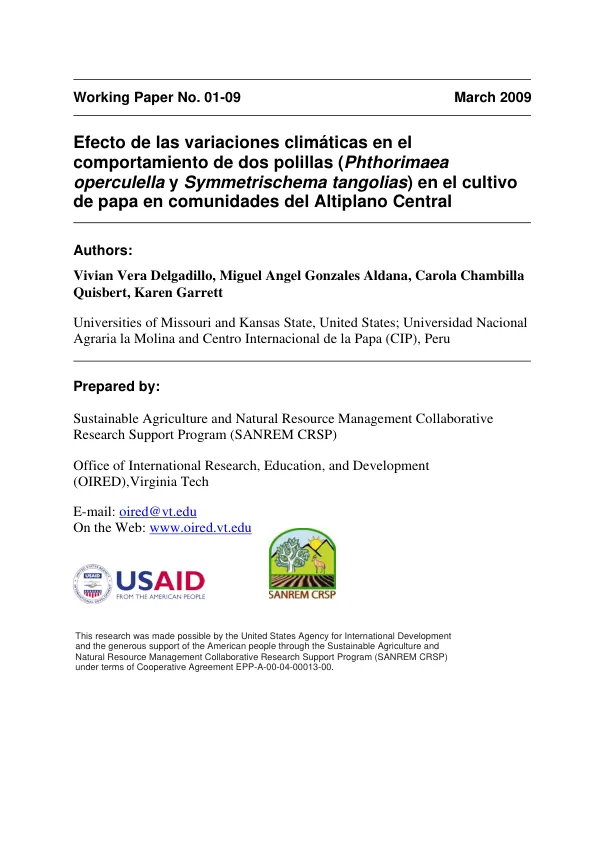
Efecto de las variaciones climáticas en el comportamiento de dos polillas (Phthorimaea operculella y Symmetrischema tangolias) en el cultivo de papa en comunidades del Altiplano Central
Sign inUSAID DEC
Efecto de las variaciones climáticas en el comportamiento de dos polillas (Phthorimaea operculella y Symmetrischema tangolias) en el cultivo de papa en comunidades del Altiplano Central
The study of the effect of climate variations on the behavior of two potato moth species, Phthorimaea operculella and Symmetrischema tangolias, in the potato crop of communities in the Central Altiplano began in 2009.
2009 · 38 pages
Sign in to readA free account is required to download.
Abstract
The research was conducted by a team of scientists from the Universities of Missouri and Kansas State, United States, and the Universidad Nacional Agraria la Molina and Centro Internacional de la Papa (CIP), Peru. The potato moth is considered one of the most economically important pests in the potato crop. The damage is caused by the larva, which penetrates the tuber to feed and creates galleries, initially superficial and then deeper, reducing its quality. The attack can occur in the field and in storage, and it has been recognized that the potato tuber is the only host of the moth. The study aimed to determine the effect of climate variations on the behavior of the two potato moth species during the development of the potato crop and post-harvest in communities of the Central Altiplano. The research focused on the behavior of the populations of the two moth species in relation to precipitation, temperature, and humidity. The study was conducted in two communities in the Central Altiplano, where the potato is a staple crop and a source of income for the farmers. The research team collected data on the behavior of the moth populations, including the number of adults, the damage caused by the larvae, and the severity of the infestation. The results of the study showed that the climate variations had a significant impact on the behavior of the two moth species. The study found that the populations of the two moth species were more abundant in areas with higher temperatures and humidity. The research also found that the severity of the infestation was higher in areas with higher precipitation. The study concluded that the climate variations had a significant impact on the behavior of the two moth species in the potato crop of communities in the Central Altiplano. The research highlighted the importance of considering the climate variations when developing strategies for the management of the potato moth. The study also emphasized the need for further research on the behavior of the potato moth and the impact of climate variations on the potato crop. The research team suggested that the findings of the study could be used to develop more effective strategies for the management of the potato moth and to improve the productivity of the potato crop in the Central Altiplano. The study was funded by the United States Agency for International Development and the Sustainable Agriculture and Natural Resource Management Collaborative Research Support Program (SANREM CRSP). The research team consisted of scientists from the Universities of Missouri and Kansas State, United States, and the Universidad Nacional Agraria la Molina and Centro Internacional de la Papa (CIP), Peru.