USAID DEC
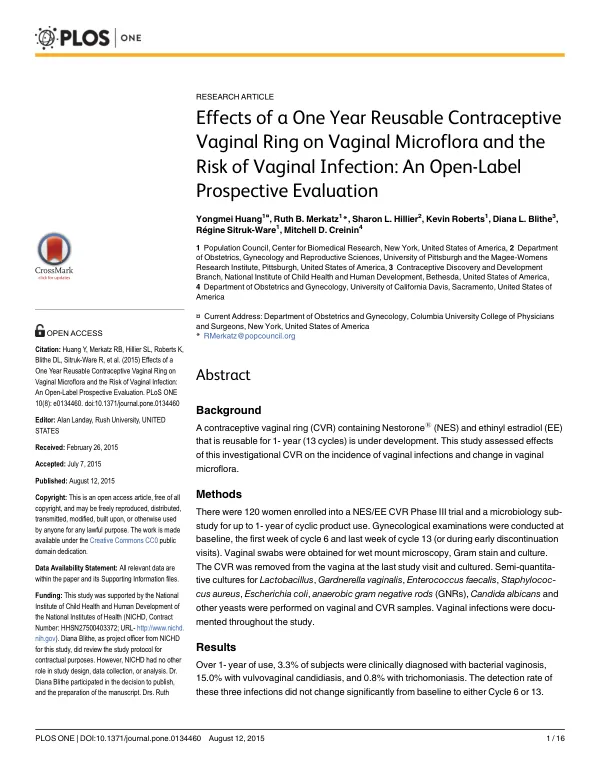
Effects of a One Year Reusable Contraceptive Vaginal Ring on Vaginal Microflora and the Risk of Vaginal Infection: An Open-Label Prospective Evaluation
Sign inPOPULATION COUNCIL
Effects of a One Year Reusable Contraceptive Vaginal Ring on Vaginal Microflora and the Risk of Vaginal Infection: An Open-Label Prospective Evaluation
The contraceptive vaginal ring (CVR) containing Nestorone and ethinyl estradiol is a long-acting, reversible contraceptive designed for one year of use.
2015 · 16 pages
Sign in to readA free account is required to download.
Abstract
The ring is made of silicone and is intended to provide safe, effective, and acceptable contraceptive protection without the need for daily action or refrigeration. The Population Council, an international non-governmental research organization, has been developing this CVR with support from various organizations, including the United States Agency for International Development, the National Institutes of Health, and the World Health Organization. The CVR contains Nestorone, a new 19-nor progesterone derivative without androgenic activity, and a low dose of ethinyl estradiol. The goal of this contraceptive is to offer a safe, effective, and acceptable long-acting user-controlled reversible contraceptive that can be inserted and removed by the woman herself. The CVR is designed to address access and service delivery issues, especially in low-resource settings where health resources are limited and the unmet need for contraception remains high. A Phase III trial of the NES/EE CVR was conducted to assess the overall safety, efficacy, and acceptability of this novel CVR. The trial involved 120 women who used the CVR for up to one year. The study included a microbiology sub-study to evaluate the effects of cyclic use of a single vaginal ring on the incidence of vaginal infections and the vaginal microbiota. The study found that the detection rate of bacterial vaginosis, vulvovaginal candidiasis, and trichomoniasis did not change significantly from baseline to either Cycle 6 or 13. The study also evaluated changes in selected components of the vaginal microbiota during ring use. The results showed that H2O2-positive Lactobacillus dominated vaginal flora, with a non-significant prevalence increase from 76.7% at baseline to 82.7% at Cycle 6 and 90.2% at Cycle 13. The median concentration of Lactobacillus was 107 colony-forming units (cfu) per gram. Although anaerobic gram-negative rods (GNRs) prevalence increased significantly, the median concentration decreased slightly (104 to 103 cfu per gram). There were no significant changes in frequency or concentrations of other pathogens. The study concluded that sustained use of the NES/EE CVR did not increase the risk of vaginal infection and was not disruptive to the vaginal ecosystem. The results of this study provide valuable information on the safety and efficacy of this novel CVR and its potential impact on vaginal health. The study's findings can inform the development of this CVR and its potential use in low-resource settings where access to modern contraceptive methods is limited.
Related documents